Creating a Theatrical Magic Act
From Theme to a Recognizable Personality
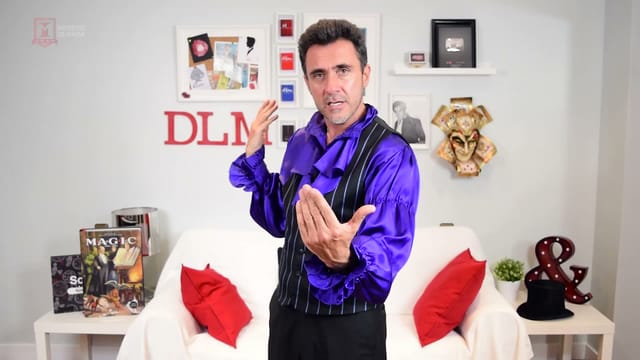
The lecture proposes a journey to build an act, starting with the unifying idea and the persona performing it. Adolfo Andrés distinguishes between thematic magic—where character, props, and effects share a theme—and theatricalized magic, where actions also respond to a story and a motive.
The first task consists of searching for a theme related to one's own interests and summarizing it in a few words. It examines why gathering available tricks first can limit construction and how to use hobbies, movies, readings, or other references to find a proposal you can develop with knowledge.
The personality can stem from yourself or a fictional figure. Two dimensions are worked on: the aesthetic, which includes wardrobe, hair, makeup, and accessories, and the attitude, expressed through body and voice. Creating a background for the character helps decide how they behave and maintain it even when a technical sleight fails.
Coherence between theme, appearance, and conduct is reviewed, paying attention to details that might contradict the proposal. The character must fit your artistic capabilities. As an exercise, it is suggested to perform with a few mastered effects and leave room for their reactions, observing afterward what worked in front of the audience.
Props, Cues, and Inner Monologue
It analyzes how to get the audience to identify props at a glance, without relying on their familiarity with standard magic shop materials. Each prop is studied for its appearance, utility, and the plot detail it brings to the story. The example of a card inside an envelope shows how appearance, reading, and a visual detail can communicate different information.
Auditory, visual, and attitudinal cues prepare the understanding of an action or a gag. The lecture compares situations presented without context against the same situations after establishing what is happening to the character.
The inner monologue is practiced as support for a silent act: first, you verbalize what the character perceives, thinks, and decides; then, you maintain that sequence without speaking. Examples with props are shown to separate surprise, contemplation, intention, and reaction, so that gestures have continuity and can be read from the auditorium. Pauses to look at the audience and share what happened without dropping character are also studied.
Rhythm, Music, and Makeup
The character's rhythm is different from speed. One exercise involves watching a performance without sound to recognize the body's cadence, without getting carried away by the music. The use of the metronome to rehearse movements and eight-counts to organize entrances, bows, and paths with the music is explained.
It works on how to adapt step length to the stage and how to choose, during learning, a rhythm that allows actions to be performed calmly. Music is valued in relation to the act's means and energy, avoiding making the character rush or leaving them without time to react.
Makeup is approached as part of reading eyes, mouth, and facial features under stage lighting. There are basic recommendations on defining the gaze, tones, and finish, as well as the importance of rehearsing with makeup on to detect issues with sweat, rubbing, or transfer to props. It is not a complete professional makeup application demonstration.
Space, Conflict, and Story Development
The arrangement of props and lighting help delimit a recognizable working space. It explains how to maintain distance relationships that allow for safe performance and how to adapt those proportions when the stage requires it.
To move from theme to story, the proposal is to first find the central conflict and then build the background and resolution. The examples serve to ask what the character needs and why a prop appears or a transformation happens. Effects are incorporated based on that dramatic need.
Movement and Expression Exercises
The physical part develops the posture the instructor calls the Eiffel Tower, applied to directing intention, reaching a stand, and moving sideways, forward, or backward. Lateral movements and turns are shown to change position while maintaining contact with the audience and orienting yourself on stage.
With the chest, shoulders, legs, and face, attitudes of well-being, bravery, defiance, listlessness, sadness, and shyness are compared. It is emphasized to accompany the emotion with the entire body and avoid contradictory signals.
You can continue the work with paper for your ideas, a prop from your repertoire, a chair or table to serve as a reference, and free space to move. Music, a metronome, and a recording help with rhythm exercises. To test the character, it is advisable to have two or three simple effects you already master. Practical instruction focuses on building and performing the act; the methods of the illusions used as examples are not explained.