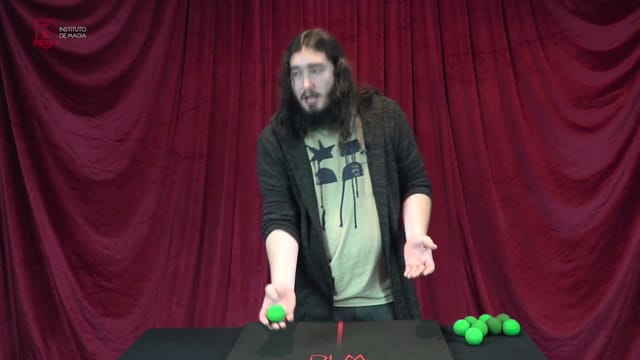
Ten Count to Ten with Sponge Balls
A routine that grows to ten balls
The ten count serves as the thread connecting several sponge ball assemblies and travels. The sequence changes direction, incorporates a break, and finishes by bringing the magic right into the spectator's hand. The climax expands the number of balls to ten.
Xulio Merino explains the complete routine and the variations that bring variety to the repetition. He reviews how to make every situation clear and how to link the phases without turning the count into a monotonous action.
Handling fundamentals
The class begins with the properties of sponge: compression, expansion, and the differences between standard and supersoft balls. From there, finger palm, a Ramsay subtle display, and the Dai Vernon false transfer are studied.
Special emphasis is placed on the naturalness of the false transfer, body language, and the relationship between gaze and attention. A brief, optional display for the routine is also explained, alongside the organization and use of pockets to load and steal props.
Everything is then integrated into the sequence. Pauses, the shift of focus between the balls, and the actions that allow the effect to happen in one place while the audience directs their attention there are all examined. The explanation of the spectator phase includes how to give directions so they close and place their hand themselves.
Choosing and maintaining your sponges
Sizes, textures, and expansion speeds are compared to decide which balls suit palms and which suit a production. Wear and tear, color fading, storage, and the wisdom of reserving a dedicated set of props for performances are also discussed.
These differences relate to real-world handling: a fast-expanding ball behaves differently when held compressed or when opening the hand. Choosing the right material is part of preparing the routine.
What to prepare and practice
To perform the finale shown, you need ten sponge balls, a working surface, and clothing with accessible pockets. No special holder is needed. You can learn the count and its variations using two balls before adding the full finale.
Basic handling is explained within the class. It is best to practice compression and palms, then the false transfer, and finally the sequence with its cues. The initial division of a ball is shown briefly; the main explanation focuses on the count, the travels, and the final production.