Garlic Aces, progressive ace location, and Quadruple Prediction
Construction and handling through three routines
The lecture brings together three card magic routines and explains the decisions behind their sleights and presentation. Miguel Ajo shows how to link actions, prepare what will be needed next, and keep the situation clear for the spectator. The explanations use the routines as concrete examples to study Ascanio's theory and a premise-based method of creation.
It is not just about knowing the technical sequence. The lecture analyzes what the audience must remember, where they are looking, what they expect to happen, and why every gesture makes sense within the fiction of the trick. The proposed work consists of rehearsing these details and recognizing how they can improve your own handling.
Garlic Aces
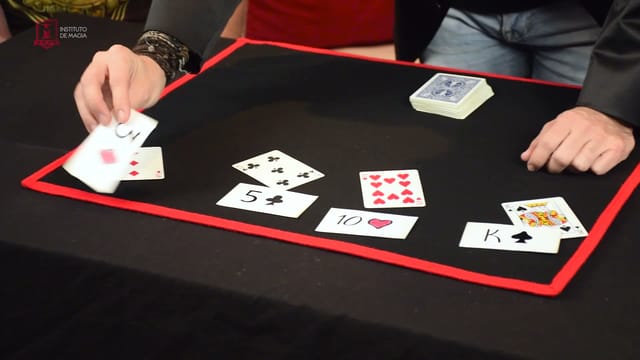
This version of Jazz Aces uses the four aces and four black spot cards. The aces travel to gather together while the story of the Bermuda Triangle unifies the presentation. The complete routine is explained, from the initial production of the aces to the final travel.
The introduction includes Ben Harris's flash production and two ways to reach its starting position. The choice and layout of the cards, the identification of each packet, and the value of keeping the triangle shape visible during the travels are discussed. The story works as a presentation framework, and the sleights are studied in relation to what that story asks of the performer.
The development includes the Braue addition, the Olram Display, the Elmsley count, a bottom double handling, and Pablo Doménech's double retention. Attention is paid to ensuring grips are linked without unnecessary readjustments and that a double can be used to point or smoothly continue an action.
Gordon Bruce's subtlety and the handling of the final vanish are also explained, featuring an adaptation of the Asher Twist and an alternative to work through that phase. The instructor compares the conditions of the repetitions: each new travel must bring more clarity, more impossibility, or a noticeable difference. Pauses and the revelation are integrated into that buildup.
Progressive Ace Location
The four aces are lost at different points in the deck. The location advances cumulatively: the first one appears, it helps find the second, both lead to the third, and all three participate in the search for the last one. The spectator intervenes by stopping the dealing, placing a card, and shuffling or cutting at the moments provided for by the routine.
The trick serves to explain working by premises. Instead of looking for changes without a specific direction, Miguel imposes conditions on himself that guide the construction; here, that the location be progressive. It is shown how a condition can guide the choice of resources and give a recognizable structure to the whole. **The explanation develops a multiple control based on the cull, cuts and shuffles that accompany the feeling of loss, a strike second deal, and transitions between findings. Finger pressure, natural positions, rhythm, and the direction of the deal are reviewed. Table space management helps the spectator's intervention arrive at the right moment.**The subsequent phases work on in-transit loads, doubles, stable holds, and the link between cards and deck. The ending uses a one-handed Ascanio's Spread, which is briefly reviewed before applying it. It analyzes why the newly found card is shown or left in a specific position and how a useful action allows the next one to be prepared without interrupting the presentation.
Quadruple Prediction
Four points in the deck are marked with cards and lead to a prediction. The presentation incorporates an apparent failure and a surprise ending, using the idea of destiny as a guiding thread. The routine is explained along with the relationship between its internal construction and the emotions it seeks to evoke.
The block proposes a criterion for apparent failures: the initial situation must remain interesting even if the failure did not occur. The value of the journey before a strong ending is also studied; the final surprise must complete a routine that already has content and clarity.
Material preparation, card handling, deck switching, and the continuity actions that sustain the identity the spectator attributes to the whole are worked on. The idea of the non-change as a construction approach is developed, and it is explained why it is advisable to temporally separate a technical action from its visible consequence.
Participation can be expanded so that part of the procedure happens in the spectator's hands, depending on how well they understood the instructions. The size of the cards, the cleanliness of the breaks, and the importance of having the decisions appear to be preserved without subsequent manipulations are discussed.
The presentation of the failure receives specific treatment: pauses, gaze, and the performer's reaction, avoiding overacting. It is studied when to continue so that the tension does not turn into sympathetic applause and how to let the prediction rest before presenting the climax. The theme of destiny is part of the trick's script. Concepts to apply to your own handling The three explanations revisit a clear initial situation, in-transit actions, the innocuous use of objects, and the welding of sleights. It studies how to prepare a break before needing it, how to distinguish between showing something and letting it be seen, and how to repeat natural gestures to maintain continuity.
The analysis is not limited to the most visible moments. It includes how to pick up a packet, remove an obstructing card, point to a spot, or change orientation. The goal of practice is for these details to respond to external action and be incorporated into the rhythm of the presentation.
Materials and requirements
For Garlic Aces and the location, you need a standard French deck and a table with space to place packets and spread cards; a close-up mat makes table handlings easier. Garlic Aces uses the four aces and four black spot cards, such as sixes and nines.
Quadruple Prediction additionally requires a blank deck, normal cards, prepared and blank cards, a wallet, and a suitable pocket. A simple cardboard stand is explained as an optional aid to organize the material. The fire wallet and banknotes appear in the instructor's presentation, but they are not the essential material that determines the routine.
This is a lecture for those who are already comfortable with the deck and want to deepen their handling. The combination of counts, doubles, cull, second deal, and Ascanio's Spread requires practice. Several techniques are explained in detail; the one-handed Ascanio's Spread receives a brief review, so it is advisable to know it or dedicate prior work to it. The routines are studied progressively, paying attention to both mechanics as well as the gaze, pauses, and words.
markdown
fields
blocks
markdown