Stage Pickpocketing: Attention, Technique and Routine Construction
Héctor Mancha presents a lecture on stage pickpocketing that combines demonstration, technical explanation and routine analysis. The opening performance serves as a reference to study how participant selection, attention, contact, patter and pacing relate to one another. The teacher covers watches, neckties, pocket items and belts, along with resources to make the theatrical outcome feel much larger than the actions actually performed.
The instruction is situated strictly within a show context where the audience identifies the performer. At the closing, Mancha outlines these boundaries and rules out applying what is shown outside of that setting. His stories about personal experiences and other pickpockets accompany the explanation; the developed work focuses on building a stage act and integrating it with magic.
Preparing the Participation
The first section stresses that the work begins before the participant even steps onto the stage. Mancha analyzes audience observation, available props, wardrobe and easy stage access. He explains why a routine cannot rely on always finding the exact same necktie, watch clasp or identical pockets. He also discusses his personal preferences when choosing volunteers and the importance he places on their attitude and response during the show.
The role of the stooge is discussed and distinguished from a prior conversation that introduces the nature of the collaboration. Next, the stage entrance is examined: accompaniment, use of names, and the rapport established with the participant. The explanation ties these choices to the subsequent development of the act, rather than reducing it to a collection of isolated manual actions.
Attention, Contact and the Meaning of Actions
Mancha explains his concept of social distance and progressive closing in. He analyzes how perception and attention shift when gaze, body movement, a question, a task or laughter come into play. The dialogue with Borja Montón allows for contrasting sensations and clarifies why the pacing and pressure of contact must coordinate with what is happening on stage.
This section differentiates visual, physical and verbal stimuli. It includes examples of observation, conversation and concentration on objects. The underlying principle studied is the relationship between a perceptible action and a smaller one, as well as the need to give meaning to movements. The memory routine provides a justification for questions and shifts in attention; the teacher compares this patter to a string of words that communicates nothing to the participant.
It also addresses what happens when an action is perceived. He acknowledges that the result depends on the individual and that getting caught can be part of the theatrical game. The transition from a more leisurely start to a faster-paced finale is studied, along with the volunteer's reaction and the moment of revelations and returns. An invariably imperceptible execution is never promised.
Watches: Recognizing, Practicing and Adapting
The most extensive technical section is devoted to watches. Mancha compares leather, plastic and rubber straps, fitness trackers, clasps on certain smartwatches, and metal mechanisms. He examines how flexibility, a strap's tendency to spring back into shape, and differences between clasps that might look similar from a distance all play a role.
The explanation covers two classic techniques and a personal variant he calls the king's steal, tied into an effusive greeting. Repetitions and clarifications regarding the grip, coordination and adaptation to various models are demonstrated. Jams and limitations are also studied: certain watches are presented primarily to recognize their features or discuss difficulties, without turning the lecture into an exhaustive explanation of every existing mechanism.
For practice, he suggests having several watches on hand and a piece of pool noodle foam adapted as a practice wrist. He explains why he prefers a mobile support over strictly static practice. A mannequin is presented as a complementary option. Observations on pressure and subtlety, along with real problems he shares having encountered, form part of the study and prevent presenting the technique as merely a matter of force or speed.
Applications with Coins and Cards
Following the watches, an improvised application with a coin is shown, and another is discussed involving a card in the participant's hand. Their function is to give context to a pickpocket action within a magic effect or simple task. Mancha explains how the technical choice shifts when hand posture changes.
He also mentions a balloon routine and sponge ball applications as potential practice frameworks. These examples do not constitute a course in coin magic, card magic or sponge magic; the coin is explicitly presented as support for a ruse, and the card transformation serves as a working scenario. To develop those applications, you should already be familiar with the magical effect you wish to use.
Neckties, Pockets and Belt
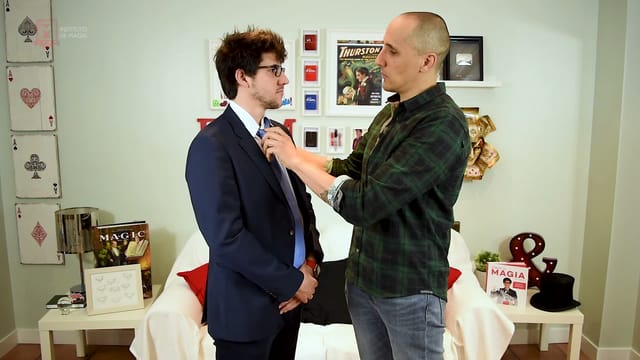
The necktie receives its own dedicated explanation, analyzing the knot, texture, wardrobe, and the preparation and revelation phases. Changes that occur when there are collar buttons are discussed, and questions regarding bow ties are answered. The latter are addressed briefly according to their fastening type, without offering a universal solution for every model.
The pocket section differentiates zones on the jacket and trousers. Using a wallet, phone, marker and other items, body cover, orientation, coordination and handling differences depending on where the material is located are studied. The instructor compares continuous actions with pre-arrangements and discusses brief applications involving glasses, a lapel pin or a brooch. The conversation highlights how clothing size, position and fit dictate what can be accomplished.
The belt is worked as a specific case, with a demonstration and explanation of how it integrates into the plot. Mancha acknowledges that it can be noticed and points out the need to consider trouser fit. Its presence in the routine is optional: it is not announced as a mandatory action nor as a substitute for selection and observation work.
The Memory Routine and Theatrical Illusion
A commentary-driven review reconstructs the opening act based on questions about clothing and objects. The relationship between text, attention, preparation, concealment and return is explained, and the changes that can be made depending on available materials are analyzed. The focus is on understanding the structure, not on reproducing every joke or packing in the maximum number of actions.
The final segment differentiates a more traditional pickpocket approach from one that combines real actions with fiction. It studies successive returns, the performer's own items, gags, and an application involving a phone and its case. These resources aim to build the impression of a larger workload and maintain character continuity. The possibility of integrating a pickpocket interlude as a complement to a magic trick is also discussed, preserving an effect even if that interlude is not fully completed.
Materials and Prior Preparation
The required materials depend on what is being rehearsed: several watches with different straps and clasps, pool noodle foam for practice, a jacket and trousers with pockets, a necktie, a belt, a wallet, glasses, a phone with a case, keys and a marker. A coin, card or balloon serve as optional props for the applications. Comedic props and the performer's additional gear belong to presentation variants and are not included as a bundle.
Mastering stage manipulation is not required to study the lecture. However, having basic experience with participants, patter and coordination is advised, as well as dedicating practice time to recognizing props and adjusting touch and timing. The closing reminds viewers to double-check returns and adapt the act to specific conditions. Mentions of books, videos, shops or contacting the instructor are references from the recording, with no promise of outside resources or personal attention included.