Always Three: Simplicidad Xuliana
Repetition that builds an impression
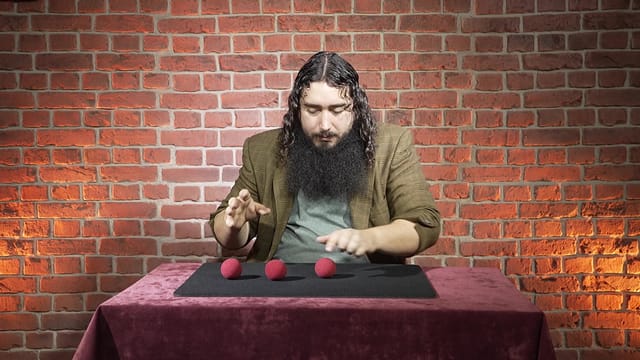
In Always Three, two balls stay in the hand and the third goes into the pocket; when the hand opens, three appear again. Xulio Merino presents his version, Simplicidad Xuliana, and explains how he organizes the repetitions so that each adds something to the whole.
The lesson includes a demonstration and an extensive explanation of the sequence. It combines practical handling with a study of structure and perception.
Preparation and the course of the routine
The version taught uses five sponge balls of the same color. Xulio explains the preparation, bringing the balls out of the pocket, and the continuity between the opening actions.
He then works through the phases, relating the finger palm, displays, and additions to the rhythm of the presentation. During the explanation he uses the side of the table to represent the pocket and make the analysis easier to see.
The study covers when to show the hands and balls, the return from the pocket, and the transitions. Repetition preserves the same effect while changing the information the spectator receives.
Each phase adds something
A substantial part of the lesson examines why the routine is built this way. Xulio analyzes the increasing attention paid to a repeated action and how to vary its presentation.
The study connects the images of empty hands, the ball’s destination, and the continuity of the effect. It also discusses a presentation detail that plays on the spectator’s possible suspicion.
The idea is to build a clear impression of Always Three progressively, rather than prolonging repetition without adding anything new.
The final vanish
The explanation develops the ending in which the balls vanish. It connects the multiple false transfer with its place in the routine and the expectation created by the sequence.
The instructor explains why he considers this the point to finish and what the vanish adds to the whole.
What you need
You need five sponge balls, a table or mat, and an accessible pocket to reproduce this version. The technical foundation includes compression, finger palm, false transfer, displays, and multiple false transfer.
You can first study the course of the actions, then return to the theoretical analysis to connect each gesture with its function. The fifth ball belongs to the specific construction Xulio teaches; the materials must match this version.
The result is a study of a complete routine, including preparation, phases, transitions, and ending, together with the reasoning that organizes its repetitions.