The glasses that flip over with a loop
A borrowed pair of glasses rests on the table and appears to turn over by itself while the magician keeps their hands at a certain distance. Julio Ribera includes a demonstration with a female spectator and then explains how to set up and perform this animation with a loop.
The effect is framed as an object that seems to come to life, rather than a levitation. Julio explains why he is interested in that presentational difference: the movement of an everyday object can be surprising without needing to keep it floating.
What is demonstrated and explained
In the performance, a pair of glasses is requested, placed on a surface, and the turn happens. The explanation revisits that sequence and shows how to integrate the setup during the normal handling of the glasses before setting them down.
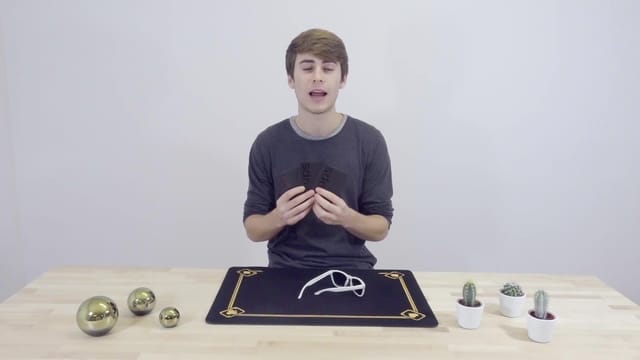
To teach the positions, a white cord representing the loop is used. This allows you to follow the setup that, in performance, is done with elastic invisible thread. You work on how to transition from the initial contact with the glasses to the position where the movement is presented.
Julio explains the gestures used to show his hands and pass them around the glasses. He emphasizes moving both hands symmetrically so that an isolated action does not seem out of place with the rest of the presentation. The tutorial ties together that setup, the placement on the table, and the moment the glasses turn over.
The demonstration ends by allowing the spectator to pick her glasses back up again. That return is part of the sequence shown; the effect is not about handing out special glasses as magic props.
Materials and prior knowledge
You need a pair of glasses, a surface for them to rest on, and an elastic invisible thread loop. The glasses can belong to the spectator. The white cord is a teaching aid and not the material used to perform the animation. No specific brand of loop is required.
The explanation assumes familiarity with the usage, elasticity, fragility, and lighting of loops that Julio covers in the introduction to levitation systems. Here, their application to glasses and the specific handling are taught; a complete course on lighting or thread care is not repeated.
To practice, link the setup with the usual handling of the glasses and then work on the coordination of both hands and the timing of the turn. The clarity of the effect also depends on how that movement is presented and revealed to the audience.