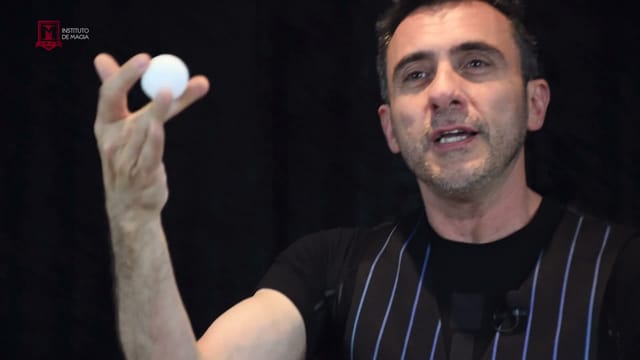
Ball manipulation: basic routine and silk finale
Fundamentals applied to a sequence
Adolfo Andrés uses a practice routine to study ball manipulation. The class begins with the differences between working with cards and round objects: the shape of the material influences the paths and the appearance of the moves. He also compares balls of different surfaces and materials, without requiring a specific brand.
The explanation covers the classic palm, the fingertip production, and a way to show the hand apparently empty. The instructor emphasizes relaxing the fingers and checking the positions from the spectator's point of view. Next, he works on finger rolling, the French Drop or false transfer, and the reappearance of the ball.
These techniques are combined with a color change and a finale featuring a silk production. The class explains both the isolated moves and how to link them together; the sequence serves to cement the fundamentals and develop your own presentation.
Movement, gaze, and angles
The gaze should follow the action of interest to the spectator. It analyzes when to fix it on a ball and how to make sense of the wand's use so that attention is not trapped in a hand waiting for its next move. Continuity between actions is part of the rehearsal, not an afterthought left for performance day.
To check angles, the instructor suggests using a mirror or the help of another person. Seeing the object from the magician's perspective is not enough to know what is perceived from the front or from the side.
Props and preparation
For the complete sequence, two manipulation balls of different colors, a wand, a silk, and a hat are used as part of the setup. You can start the basic exercises with just one ball. Preparation and handling are explained; you do not need to buy a specific brand.
It is best to work on each position with a relaxed hand and each transition at a comfortable pace before stringing together the productions, the color change, and the finale.