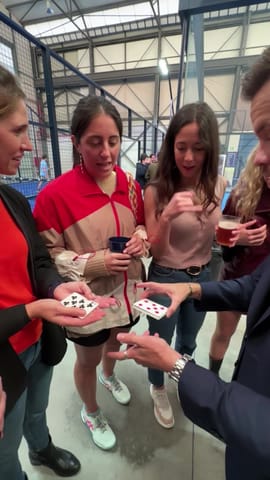
The spectator-held prediction: handling with the Biddle steal
A card is set aside as a prediction and appears to be placed inside a small packet held by the spectator. Afterwards, the participant chooses from the cards shown to them. When the packet is retrieved, the card at the indicated position matches that choice.
Pablo Costas performs and explains this routine from his close-up magic repertoire. The lesson includes a live performance with an audience and a tutorial that repeats the presentation, breaks down the handling, and recaps the complete sequence.
Building a prediction that the participant keeps
The beginning provides a reason to insert the card into a packet and leave it in someone else's hands. Pablo explains how to show the placement and point out the position so the audience remembers where the prediction ended up.
The number used in the demonstrations varies: the teaching does not depend on it always being the sixth or seventh card. What is studied is the clarity of the position and the continuity between the initial placement and the revelation.
The identity of the prediction does not remain visible throughout the routine. The effect is built upon the impression that the card is already put away before the choice is made.
The fan across the deck
The first technical section uses a fan of a packet smaller than half the deck. Pablo details the grip and support over the rest of the deck to distribute the cards and show where the prediction is inserted.
The closing, orientation, and handling of the packet received by the spectator are also covered. The explanation revisits that sequence to connect what is taught with what the participant believes they are holding.
The buckle and passing the cards
The second technique combines a buckle with the handling of the cards being shown. Pablo explains the grip and hand coordination, with repetitions to observe the action within the rhythm of the selection.
The lesson explores how to maintain an appearance of continuity while the participant indicates when to stop and confirms the card they want to use. They are not required to choose a specific value, nor does the prediction require a specially prepared card.
The Biddle steal
The tutorial explains how to obtain and maintain a break while showing the selection and how to incorporate the Biddle grip steal into the verbal patter.
You will learn how to give purpose to questions about the chosen card and how to link the handling with the rest of the sequence. The gesture of an invisible toss is then used as a presentation to connect the selection with the packet held by the spectator.
The opening and the revelation
Pablo demonstrates a direct finish and adds a subtlety to retrieve and open the packet more seamlessly. The explanation takes advantage of the natural curvature of the cards and discusses how to set them up before the effect if necessary.
The separation that facilitates retrieval, the opening of the fan, and the continuity with the revelation are examined. This is an adjustment to the same climax, not an independent second routine.
The recap allows you to place the fan, the buckle, and the steal back into the overall structure, along with the patter and cues given to the audience.
Materials and knowledge
You need an ordinary deck and a participant who can hold the packet. Pablo also mentions using a table for support and recommends a small close-up pad for his table-hopping work; the pad is a performance preference rather than a special prop required for the method.
It helps to be comfortable with basic grips and card handling. The lesson covers the three main technical applications, although the fan and maintaining a break require practice to integrate naturally.
Pablo Costas is the one performing and explaining the routine. Brand marks on the deck and references to his social media are part of the recording's context; they do not imply any mandatory purchases or materials other than those specified.