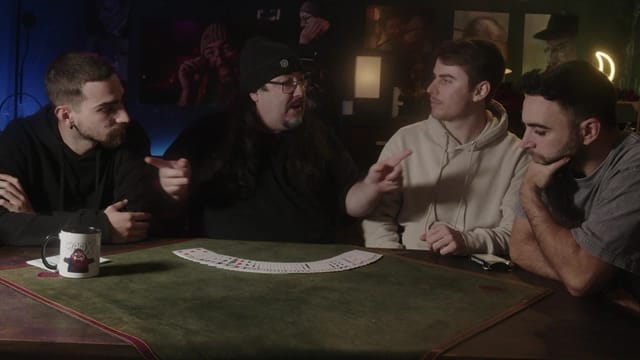
Chosen Card and Thought-Of Card: Routine and Blackout
A participant chooses a card and another thinks of a different one. Dani Daortiz presents the effect as a memory test: after they exchange the positions of their cards and shuffle, he reveals both identities. The lesson includes the performance and an explanation that combines handling, communication, and memory construction.
Here and Now and Blackout
Before explaining the main routine, Dani introduces the Here and Now: an action that seems to change due to a circumstance that has just arisen. The examples study how that event gives meaning to the continuation and the appearance of naturalness.
He then presents Blackout within his model of memory and attention. He relates it to the coincidence of a punctuation mark, a closing door, and a Here and Now, and distinguishes it from Arturo de Ascanio's parenthesis of oblivion.
The teaching analyzes moments that he seeks to leave out of the spectator's reconstruction. His examples are studied as Dani's presentation resources, not as a promise that a person will always forget a specific action.
Examples illustrating the concept
The explanation uses a card case production and a card identification example to show that combination of circumstances, dialogue, and continuity. It reviews the role each resource plays in what has just been presented.
The card case example uses two decks with different backs. That material belongs to the prior illustration of Blackout; it is not a requirement for the main chosen card and thought-of card routine.
An ordinary deck routine
Dani points out that the main trick can be done with a borrowed and even incomplete deck. It requires neither a set stack nor actually memorizing the entire sequence of cards shown in the presentation.
The explanation develops the use of a key card and the peek that allows it to be established. It works on how to receive the deck and how to relate that gesture to body placement and distance, seeking to make the handling fit the action taking place.
Managing expectations
The content distinguishes the physical choice of a card from the card thought of by the other participant. Dani explains why he asks them to verify that they do not match: he wants to prevent the audience from expecting a coincidence, which is not the effect he is going to perform.
Next, the moment of spreading and observing the cards under the pretext of using memory is developed. The technical preparation and the time left before looking are related to the conversation, without rushing the actions that allow the continuation.
Exchange and justification of the peek
The participants exchange their cards while Dani is turned away. The explanation analyzes body posture, the moment to turn around, and a cue to square the deck that gives meaning to that action within the presentation.
That is the Blackout applied to the main routine. The apparent event, the punctuation mark, and the justification are reviewed to connect the initial concept with a specific moment of the routine.
Finale and practice
The version shown ends by naming the two cards after the shuffle. Dani mentions that knowing both identities allows choosing another resolution; the closer demonstrated and explained here is the double divination.
You need an ordinary deck, space to spread the cards, and two participants to practice the presentation as shown. The handling uses a key card, peeks, and body communication, without requiring a special commercial deck. It is worth studying how instructions, gaze, and pauses are linked: the explanation focuses on giving meaning to the technique within the interaction.