Transparent prediction: from drawing to folded card
A drawn card becomes a physical card
The presentation starts with a transparent sheet and a drawing of a folded card. After the selection, the drawing apparently becomes a physical card, which is removed, unfolded and shown to match the spectator's choice.
Julio Montoro presents the idea as a transparent adaptation of Sketch. The tutorial develops the construction and routine using acetate, cards, magnets and adhesives. The selection is directed to the card prepared as the prediction.
Materials and drawing preparation
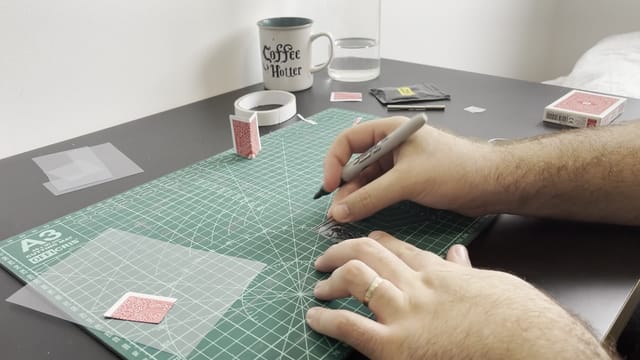
You need thin transparent acetate, four very thin magnets, double-sided tape, adhesive tape, a permanent marker, scissors and cards. The tutorial uses Pro Magnets; comparable supplies must respect the thin format of the assembly. A commercial kit is not stated to be included.
One card serves as a drawing and cutting guide. You also need the folded prediction card and another of the same identity in the deck. The template is reduced so the physical card covers the drawing and its preparation. Construction includes the acetate pieces, drawing lines, magnet positions, tape and marker touches that integrate the assembly into the apparent drawing.
Folded card and hand load
Montoro checks the dimensions and trims protruding parts to align the folded card with the drawing. He then works on the adhesion that holds the preparation and allows separation during the effect.
Reduced-tack double-sided tape is shown for the hand load; magician's wax is mentioned as an alternative. The explanation covers the grip, the appropriate moment to show the hand and the gesture that produces the card. The sheet can look transparent initially, but while the prepared drawing is in place its orientation must protect the work on the reverse.
Presenting the prediction and directing the choice
Taking out the marker links to positioning the prepared drawing and apparently drawing the prediction. Montoro explains putting the sheet aside and continuing with the deck.
The choice must match the prepared prediction. A force is assumed and possible ways to integrate it are discussed; this is not a freely chosen, signed card. Practise a force before combining it with the load and appearance. Putting away the deck provides an opportunity to position the folded card; carrying it behind the deck is another loading option within the same routine.
Appearance, opening and finish
The hand approaches, the pieces come together and the real card appears. The whole drawing assembly is then removed so the acetate can be shown clear, and the card is opened to reveal the prediction.
Clearing the sheet is taught. For a possible handout of the card, an additional finish that hides or removes its preparation is mentioned as an adjustment at the end. This does not make every component freely examinable throughout.
The lesson combines construction with hand handling and audience attention. It requires preparing the acetate and magnets, adjusting alignment, and practising the force, load, sheet orientation and final separation.