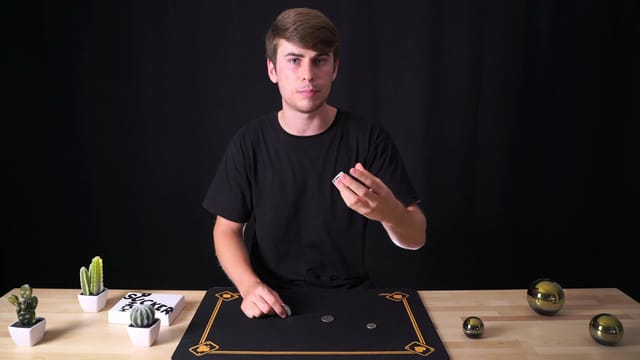
Coin Magic Fundamentals
What You'll Be Able to Do
You'll learn how to choose the right coins for your hands and how to make your magic look natural rather than stiff. By the end of this lesson, you'll know how to analyze your own movements to ensure your sleights are indistinguishable from your real actions.
How It's Structured
This lesson breaks down into two core areas: the physical tools and the theoretical performance. We start by looking at why the size and type of coin matter for your hand mechanics. Then, we move into the "why" behind your movements, teaching you a simple, repeatable process to analyze your own technique so you can perform vanishes and transfers with total confidence.
What's the Difficulty
This is a beginner-friendly lesson that focuses on building good habits early. You don't need fancy props, just a few coins and a willingness to practice your mirror work. The challenge here isn't a complex finger movement—it's the mental discipline required to make your "fake" moves look exactly like your "real" ones.
About the Instructor
Julio Ribera is a seasoned performer and teacher known for his ability to translate complex magic theory into practical, everyday skills. He’s spent years refining his approach to close-up magic, helping over a million students learn how to create moments of impossibility.
What's Included
- Why US half dollars are the industry standard for learning
- The connection between coin size and natural palm mechanics
- How to use "real-world" movement to perfect your vanishes
- The secret to keeping your hands looking empty after a move
- Using symmetry to sell the illusion to your audience
- Tips for "breaking in" your hands so a coin feels like an extension of your body
Frequently Asked Questions
Can I skip around or should I watch in order?
Watch in order. The first video on choosing coins provides the foundation you need before you start analyzing the movements in the second video.
How much practice between sections?
Don't worry about speed. Spend time just holding the coin and getting used to the weight. Practice the "real" toss movement until it feels automatic before you try the fake version.
Is there a way to check if I'm doing it right?
Use a mirror or record yourself with your phone. If you can spot the difference between your real toss and your fake toss, your audience will spot it too. Keep practicing until you can't tell the difference yourself.
What if I get stuck on one part?
If a move feels awkward, you’re likely overthinking the finger position. Go back to the "real" action—how would you actually move if you were just passing a coin to a friend? Keep it simple.