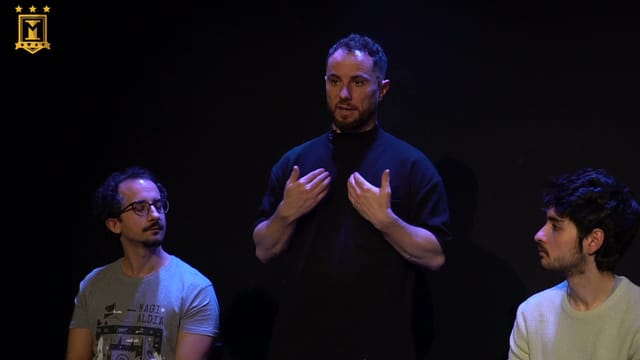
Character Building and Stage Improvisation
The stage character is also built by observing how you act, listen, and react when something surprises you. Gerard Clúa combines physical preparation, reflection, and exercises with participants to explore that identity. The class focuses on performance and stage presence; it does not teach a specific magic effect.
Stay relaxed without losing energy
The session begins by distinguishing relaxation from passivity. The goal is a body available to move and respond, without confusing stage energy with constant tension.
A seated warm-up is guided, moving across the body with light taps, gentle contacts, and friction. The imagery of a shower, soaping up, rinsing, and drying helps organize the sequence. The instructor uses this as a way to pay attention to the body and enter the rehearsal mindset.
Next, breath release is worked on with a sustained "s". The difference between expelling it all at once and maintaining a more regular output is observed, avoiding strain. There is also a brief articulation demonstration using a pen and a familiar text. These are introductory vocal preparation proposals, not a complete voice technique training.
Differentiating the performer from their character
Gerard presents the character as an elaboration of one's own personality: certain traits are amplified and put at the service of the performance. It does not necessarily consist of inventing a completely foreign identity or copying another artist's energy.
It is analyzed how that distance can help play with mistakes without turning every stage stumble into a judgment on the person. The instructor presents this as an acting and rehearsal tool. He proposes observing what happens before discarding a reaction because it seemingly does not fit the character.
The examples of the antihero and the white-face clown allow for a comparison of rhythms, attitudes, and ways of tackling a problem. The character's desire is also introduced: what they are trying to achieve in the scene and how their role conditions the path to that objective. The artist continues to attend to the energy and the audience while letting the character respond to the circumstances.
Exercises to recognize your reactions
The improvisations are performed before the instructor, who interrupts or comments on them to point out actions, blocks, and possibilities:
- King and Lackey: a relationship of authority and service allows exploring different roles, accepting offers, and building a situation through actions.
- Story with Questions Only: the difficulty of sustaining it makes hesitations and self-judgment visible. One observes what information those reactions express.
- Story without "Yes", "No", or Questions: restrictions help detect automatic responses and impulses. Mistakes become material to study the character.
- Newscast with Gestures: one person tells an invented news story and another physically portrays it; then they switch roles. Listening, adaptation, and the difference between speaking and responding with the body are worked on. This is not a sign language exercise.
The invented situations are practice material, not closed scripts to incorporate into a show. The interest lies in recognizing how each performer responds and using that information to create.
Presenting the character and sustaining the relationship
In another exercise, a participant describes a character that their partner prepares offstage. Afterward, they introduce them, the partner enters, shows their traits, interacts with the audience, and exits. Fantastic characters and a restaurant situation with an overwhelmed waiter are rehearsed.
Corrections focus on making a readable entrance, sustaining what has been proposed, and knowing how to close the intervention. The first impression caused by the entrance is analyzed, along with how the subsequent intervention develops it. It also shows how excessive energy can prevent listening to the partner, even if the character has a reason to be agitated.
The session ends with an improvisation by the instructor himself and the idea of "yes, and...": accepting what arrives and adding an action that allows continuation. That attitude relates to inviting a spectator to participate, listening to them within the shared game.
Preparation to practice
You need a chair and space to move around. The warm-up can be followed individually; to reproduce the scenes and role swaps, another person is needed. A brief text you already know serves as support for working on articulation.
No magic props or specific card sleights are required. You should be willing to improvise, observe your impulses, and repeat a situation incorporating the corrections. You can start without having a defined character: the exercises are precisely oriented toward finding your own traits and giving them a stage form.