Thimbles: palms, vanishes, and transfers
Basic handling and thimble exercises
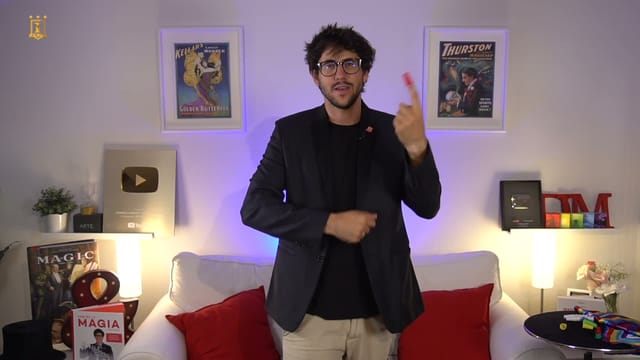
Borja Montón explains the techniques used to make thimbles appear, vanish, and travel between the fingers and hands. The work is framed as a practice sequence to get familiar with the prop and link movements together, rather than as a fully built professional act. Each sleight is broken down with details on how to improve grip and reduce unnecessary gestures.
Choosing the material
Short and long thimbles, smooth and ribbed, are compared, discussing how shape, fit, and texture affect the grip. Borja explains why he prefers long thimbles for his handling and what to watch out for when choosing other materials. He also analyzes the color contrast between the thimble, wardrobe, and background, as well as audience distance in close-up, parlor, and stage magic.
Simple thimbles or appropriately sized bottle caps can work to start. 3D printing is mentioned as an option to experiment with sizes and textures, though no design or printing guide is included.
Palms and finger control
The core technique is the palm referred to by the instructor as the "Italian" palm or Nelson Downs palm. Its entry and recovery are explained, focusing on the path of the finger, the firmness of the grip, and the economy of motion. The exercises let you check if the thimble remains secure before increasing speed.
The pass between the index and middle finger is also practiced, along with coordinating those positions with the palm. The goal is to be able to free a finger or a hand without the handling looking stiff or awkward.
Vanishes and subtleties
The class compares a vanish based on a large movement covering a small one with other variants where the hand acts as a screen. Differences in rhythm and position are shown, along with middle finger applications and an optional sound detail. Borja discusses which variants he prefers and which he uses less.
A vanish around the hand is also explained, presented as a flourish, alongside a handling to show the hands apparently empty and recover the thimble. Its angle limitations and the need to orient the body relative to the audience are pointed out. The French Drop appears as a brief application to this prop, without being developed here as an independent study.
Finger switch, transfers, and coordination
The finger switch allows you to transfer the thimble to another finger within a broader action. Its use for vanishes and reappearances is practiced, taking care of finger positioning so the change remains invisible. The repeated production sequence incorporates a transfer with two thimbles and highlights the importance of picking up each one in an orientation useful for the next action. Travel and alternation exercises between both hands are suggested, with variants at different heights. The instructor stresses the importance of also practicing with your weaker hand and avoiding repetitions that drag out the effect without adding clarity. Materials, practice, and scope
You will need thimbles that fit your fingers; two identical ones allow you to follow the transfers and exercises with both hands. You can start some movements with a suitable bottle cap. For the sequences that use them, have a pocket or a container ready to deposit and retrieve them. Practicing in front of a mirror can help you review the result from the audience's perspective.
The explanation starts with basic handling, though achieving fluidity requires practicing coordination and angle control. No prior lesson is assumed. Color changes and final productions of multiple thimbles are mentioned or anticipated, but they are not part of the technical explanation developed in this video. The colored handkerchief shown is also not necessary for the exercises taught.
finger switch
allow