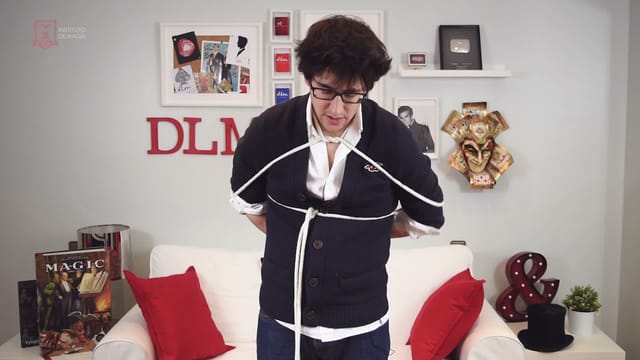
Jacket Escape: Suspense and Audience Management
The jacket escape combines a situation of apparent immobility, a visible transformation, and a final release. Borja Montón presents the routine as a parlor or stage piece whose strength depends on the rapport with the participants and the clarity with which the audience follows the stakes.
The first part examines suspense through three resources: the mystery that sparks a question, the conflict that introduces uncertainty, and the anticipation that delays an expected resolution. The examples make it possible to distinguish between concealing an action and building expectation. Counting, interruptions, and pauses serve a dramatic function when the spectator understands what they are expecting to see.
The technical explanation covers the bindings, the preparation of the ropes, and the sequence of actions necessary to perform the two phases of the effect. Each procedure is linked to its justification before the audience and the performer's comfort. Working with a borrowed jacket is part of a structure that continues until the complete escape and the return of the garment.
Staging requires coordinating three participants with different roles. Their selection, the instructions for holding and moving the canvas, the placement of the material, visibility from the audience, and angle checks are all reviewed. Fabric opacity and the interference of glasses, cables, or microphones during performance are also taken into account.
The humor stems from the situation and the participants' responses. Borja explains how to adapt the jokes to the audience, maintain stage direction, and prevent comedic bits from diluting the goal. Following the appearance of the jacket, silence allows the change to register before initiating the next phase.
The study concludes with a review of the presentation and its references. As a rehearsal exercise, it is suggested to review the sequence with its props and apply the three suspense resources to other effects in one's own repertoire.