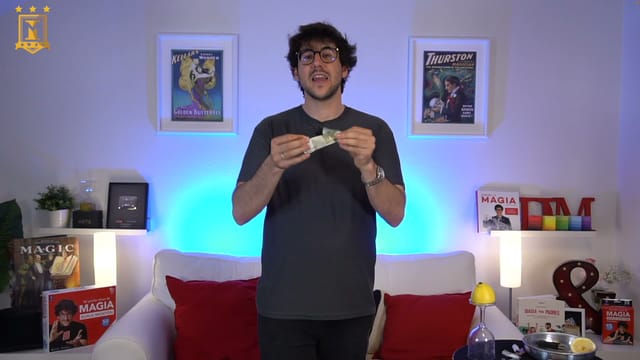
Thumb Tip: accessories and banknote magic
Thumb tip applications and related accessories
Borja Montón expands the possibilities of the thumb tip with examples of productions, switches, light, and object animation. The class combines an overview of accessories with more detailed practical explanations: a silk production, a signed banknote switch, its application to the banknote in lemon routine, and a successive banknote production.
Choosing a tool based on the effect
Various uses of the thumb tip are discussed: concealing small objects, providing continuity to an action, simulating a presence or a sound, and supporting other props. These examples help you consider what the audience needs to perceive before choosing a tool.
The overview includes holders and stoppers, models of varying capacities, a prop for confetti, and another for coin productions. Their possibilities and handling differences are explained. The Miser's Dream and the salt pour routine are mentioned as usage references, though their complete routines are not taught. An artificial hand is also shown as an example of theatrical continuity.
Light, animation, and silks
Borja presents luminous accessories like D'Lite and Sanada-related models. Light visibility and environmental influence are discussed. A butterfly and a quill that appears to write by itself are used to explain how to adapt movement to the character of the object and pay attention to lighting.
The production of a silk handkerchief is demonstrated and explained using a Sanada, including its preparation and handling adjustments. Other devices, such as Magma and Tarantula, are presented for their potential applications; neither a complete routine nor an operating tutorial for each product is provided. Some of the accessories shown are incomplete or uncharged.
Signed banknote switch and application to the banknote in lemon
The core work is a banknote switch that allows you to hand the bill to a spectator and continue the presentation naturally. The preparation of the paper, the coordination of both hands, the handing out, the justification of actions, and details on showing the hands empty are explained. Borja repeats the handling and discusses how to reduce unnecessary movements.
He then applies it to a version of the banknote in lemon: the signed banknote ends up inside the fruit. The preparation of the material, its placement in the case, the sequence of actions, and a way to practice in parts are examined. A finish using plastic wrap is also shown, and it is explained why the signature allows the bill to be recognized without interrupting the climax to check its serial number.
Borja presents this version as a work in progress. The technical explanation is included, but the demonstration contains pauses and rehearsal commentary; it is neither a complete public performance nor a finished stage routine. You can work on the banknote switch separately and decide how to incorporate it into your own presentation.
Successive banknote production
The class ends with the appearance of six banknotes of different denominations. A fold that allows for quick opening is taught step by step, repeated from another angle, and the capacity of the necessary prop is discussed. The version shown uses a commercial set of same-sized prop bills; you should not assume that any combination of real bills and a thumb tip will work the same way.
What you need to practice
It is helpful to know the basic handling of the thumb tip and to be comfortable showing your hands empty, as well as stealing and ditching the prop. The banknote switch and transitions require coordination and practice.
For the banknote work, you will need a suitable thumb tip, prop bills, a marker, tweezers, and an organized place to set up your materials. The banknote in lemon application adds lemons, plastic wrap, a stable stand, and small prep tools explained in the video. The multiple production requires a higher-capacity prop and compatible bills. To practice the silk production, you need a silk handkerchief and the corresponding prop. You do not need to acquire the entire collection presented to work on one of these applications.
The recording includes fire and mentions of sharp or electrical accessories; it does not constitute safety training for their use. Practice the handlings without flame and do not interpret the presentation's jokes as safety measures.
The class also includes bibliographic recommendations for further study on the thumb tip. The books and accessories are discussed as references; they are not included as downloadable materials.