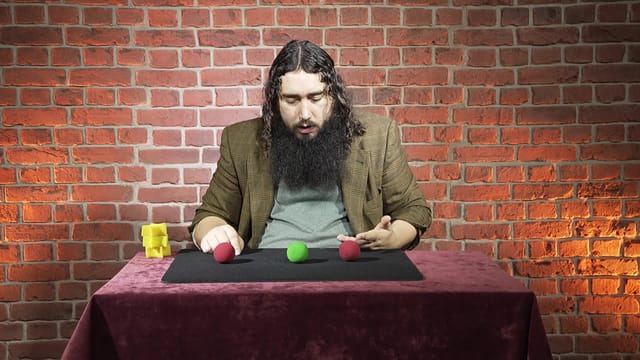
Ghost Balls: variation with colors and stars
This variation uses color to make the Ghost Balls situations clearer and to reinforce the final production. Xulio Merino explains how he incorporates red and green balls and replaces the climax involving a large ball with three yellow sponge stars.
The second color is not intended here as a constant color change. Its primary function is dramatic: to help the audience better identify a ball, clearly perceive which ones are together, and witness a travel with greater impact.
An adaptation of a well-known routine
The video assumes you are familiar with My Ghost Balls. Xulio reviews its structure to contextualize the variation, but he does not re-explain from scratch all the productions, travels, and handlings of the original routine.
The points where he introduces the ball of a different color are highlighted, while the mechanics of the Always Three and Pass-Pass phases are preserved. The learning process consists of adapting that structure and understanding what each visual gains by changing the props.
Contrast on the table and in the spectator's hand
Xulio compares images of two balls of the same color with ones of different colors. He explains how the clarity of a display increases and how contrast helps to perceive the travel of a ball.
He also applies this criterion to the spectator's hand: what matters is which ball they believe they are receiving and what color they see before closing their hand. The variation works on that perception, in addition to the sleight of hand.
Preparation and finale with stars
The explanation covers the organization of the props in the pockets and the placement of the three stars relative to the finale of the previous version. By introducing a second color during the performance, the third color in the climax arrives within a presentation that has already emphasized color.
A workshop on how to make the stars is not included. They are simply part of the necessary props for this version of the finale.
The bargain change
Xulio breaks down the change he calls the bargain change, a three-for-two substitution used to lead into the production of the stars in the spectator's hand.
He explains the handling, the transfer, and the attention needed for side angles. He also points out the spacing between the tips of the stars so that the pieces do not snag during the action.
Props and prior knowledge
You need the props for the Ghost Balls routine, featuring red and green balls, three yellow sponge stars, and pockets to organize the loads. The ring belongs to the starting structure mentioned in the explanation.
It is advisable to know that routine and its displays, transfers, and spectator phases before studying the variation. No specific brand of sponges is required, nor is any mandatory commercial product specified.