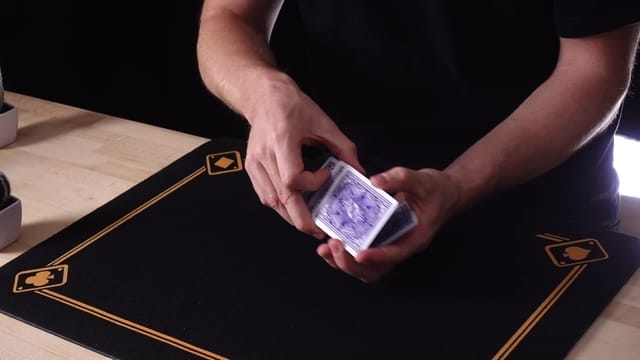
Hindu Force
What Most People Get Wrong
Many beginners think they need fancy, high-speed moves to force a card. They worry that a simple shuffle looks too obvious or that the spectator will catch on immediately. Because of this, they avoid the classics and focus on moves that are way harder than they need to be.
Why It Matters
When you master a simple force like the Hindu, you stop worrying about your fingers and start focusing on your performance. The magic doesn't happen because of a complex secret move; it happens because you act like you are just shuffling the deck. When you perform it with confidence, the spectator has no reason to doubt that their choice was completely random.
What You'll Learn
You'll learn how to use the Hindu shuffle to control a card so that no matter where the spectator says "stop," they end up with the card you want them to have. We cover the mechanics of the shuffle, how to keep your force card at the bottom, and the importance of the "tap"—a small, subtle gesture that creates a break in the action. This helps the spectator forget that you are just dealing from the top of the deck.
Julio Ribera has been performing and teaching magic since he was a teenager. He focuses on practical techniques that work in the real world, rather than theory that only works on camera. His approach is all about making magic accessible so you can get reactions right away.
What's Included
- Setting up your force card at the bottom of the deck
- Executing the Hindu shuffle without moving the bottom card
- Using the "tap" to create a natural pause for the spectator
- Displaying the card with confidence to sell the effect
- Combining the force with other routines
Frequently Asked Questions
What if I’ve been doing the Hindu shuffle wrong for years?
That’s fine. The key here isn't the shuffle itself, but the control. Once you realize the bottom card stays put, you can fix your technique in a few minutes of practice.
Is this the only way to force a card?
Definitely not, but it is one of the most reliable. It works because it looks like you are doing exactly what you say you are doing: shuffling.
How do I know when I’m doing it right?
When you can perform the shuffle while looking at the spectator instead of your hands, you’ve got it. If they feel like they had a free choice, you’ve succeeded.