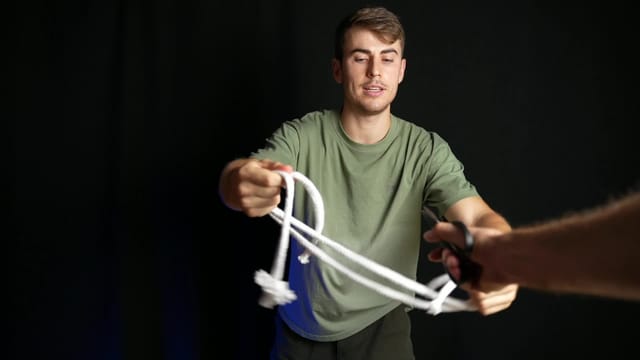
Hocus Pocus Cut and Restored Rope
What Most People Get Wrong
Many magicians think a rope restoration needs complicated knots or hidden gimmicks to look real. They often struggle with awkward hand movements that make the rope look tangled rather than like a single, solid piece.
Why It Matters
When you master the natural handling of the rope, the magic happens in the spectator's hands. By letting them "cut" the rope themselves, you remove the suspicion that you're doing something tricky. This version looks clean because the restoration happens in a smooth, continuous motion that hides the secret loop perfectly.
What You'll Learn
You'll learn how to set up the Hocus Pocus rope move, which lets a spectator cut a tied rope in half before you instantly restore it. The secret lies in a specific sequence of twists and loops that you can do with one fluid, upward motion.
We break down the finger work required to keep the loop hidden behind your hand, ensuring that when you pull the ends, they appear to fuse back together. You'll also learn how to position the rope so your hands look relaxed and empty, rather than tense and suspicious.
About the Instructor
Julio Ribera is a Spanish magician who has spent years performing and teaching street magic. He focuses on practical, visual routines that you can perform anywhere, with minimal props.
What's Included
- Creating the secret loop with a half-twist sequence
- Proper finger positioning to hide the loop from view
- The "cut" procedure that involves the spectator
- Smooth handling to make the restoration look instantaneous
- Tips on keeping the loop in front for cleaner angles
Frequently Asked Questions
What if my rope is a different length?
The technique works with any standard length of rope. I use a shorter piece here so it stays in the camera frame, but you can use a longer rope to make the effect even more impressive.
How do I know if the loop is hidden well enough?
The key is to keep the loop in front of your hand, not behind it. If you practice in front of a mirror, you'll see exactly when the loop is exposed. Once it's tucked correctly, your hand will look completely natural.
Is this hard to learn?
It’s an intermediate move. You’ll need to practice the twisting motion a few times to get the rhythm, but once you get the feel for how the thumb grabs the loop, it becomes very reliable.