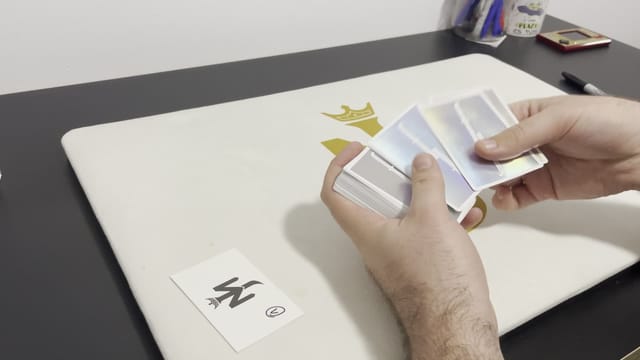
The Business Card Finds Two Cards
Two locations with an auxiliary card
The participant names a card and the patter seems to take a different turn: the magician pulls out their business card and then asks for another card to be physically chosen. The auxiliary card vanishes and reappears next to that selection. In a second phase, it vanishes again and finds the card that was named at the beginning.
Julio Montoro explains the complete sequencing of both phases. The second card is spoken aloud before starting; this is not about guessing a thought that the participant never communicates. The routine relies on deck handling, two auxiliary cards, and the distribution of actions between the magician and the spectator.
What the videos include
The tutorial presents the effect with business cards, explains positional preparation, and walks through the sequence again. The bonus video features a demonstration of the original version performed for a female participant, using a card from a different game as an auxiliary piece. That demonstration allows you to follow the two locations as presented to the audience; it does not add a separate explanation that replaces the tutorial.
Two cards, orientation, and markings
You will need a standard deck and two identical business cards, smaller than the cards in the deck to take advantage of the taught handling. Julio shows which pocket he places each one in, what orientation the card to be loaded needs, and how searching for the card allows the other to be introduced into the deck.
The signature in the example is a mark belonging to the magician himself. He also suggests writing the spectator's name if you know it beforehand and can prepare the corresponding card. That variant requires that prior information; it is not presented as the duplication of a new and unrepeatable signature that the spectator freely makes during the trick.
Preparing the named card and the selection
The explanation shows how to locate and control the named card while the patter shifts toward another action, keep its position during the shuffle, and load the auxiliary card. Afterward, work is done on the selection upon saying "stop", the packet handling, and the placement of the card relative to the chosen card.
Julio covers pinky breaks, and handling two cards as one. It is advisable to be comfortable with controls, palms, and double lifts so you can also focus on your instructions to the participant. Their applications to this sequence are explained; this is not a complete course on those fundamentals.
Vanishes and spectator cuts
The first vanish is integrated into the action of covering the card with a card from the deck. The explanation connects that action with the position of the two selections, so that the first revelation leaves the second one set up.
For the other vanish, Julio demonstrates a finger handling with a pinky action and hand cover. He insists on the difference between the explanation angle and the frontal view that flatters the image. He also reviews the retrieval of the auxiliary piece to the pocket to arrive at a clean finish.
The participant's cuts take advantage of the smaller size of the card within the deck and the instruction to cut approximately in the middle. That management is taught; it is not promised that any arbitrary cut, from any point or without instructions, will always produce the same result.
Preparation, practice, and finale
You do not need to make a gaffed card or use adhesives. The impromptu proposal uses ordinary materials, but requires having the two identical cards, placing them in the pockets, and preparing the positions during the handling. The variant with a pre-written name adds its own particular setup.
The routine ends with the removal of the additional piece and the possibility of examining the material left in play. It is advisable to rehearse the load, the orientation, the two vanishes, and the transitions so the spectator remembers two clear journeys of the same card: one toward their physical choice and another toward the card named at the beginning.