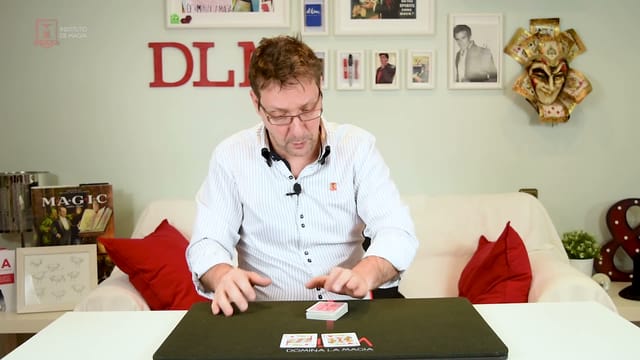
Faro Shuffle: Probable and Impossible Sandwich
Luis Otero pairs the study of the Faro Shuffle with a two-selected-card routine. Two red kings serve as locators: the first revelation is presented as an unlikely coincidence and the second as a visual appearance. The full performance leads into the explanation of the shuffle, the underlying principles, and the handling of both revelations.
Preparing and Executing the Faro Shuffle
The instruction begins with the condition of the cards and preparing the edges using very fine sandpaper. Topics covered include squaring the deck, dividing it into halves, the grip, and applying the correct pressure to achieve a one-to-one interweaving without forcing the cards.
The differences between an in faro and an out faro, top or bottom entries, and the straddle variant with uneven portions are explained. It also demonstrates how to check the division using a faro check and how to correct an imprecise cut without turning it into a presentation issue.
Otero suggests practicing with a stopwatch and comparing times across series of eight faros. Rehearsing is presented as a way to gain precision and familiarity with the pressure while maintaining a calm demeanor in front of the audience.
A Sandwich with Two Revelations
The application combines the shuffle with a mathematical principle that allows you to organize the selected cards after the spectator's intervention. The selection of two cards, the introduction of the locators, the cuts, and choosing the appropriate faro variant for the situation are explained.
The handling includes a pinky break and a spread cull, explained within this context. It examines how to maintain the order of actions and give clear instructions so the spectators themselves remove the cards and participate in concluding the sequence.
The construction utilizes the one-ahead principle and the contrast between the two revelations. It analyzes the importance of preserving the immediacy of the second effect. A final review revisits the whole routine and shows how to resolve situations that may arise during the cuts.
Materials and Practice
You need a standard deck in good condition and, for the demonstrated preparation, very fine sandpaper. The red kings are taken from the deck itself and can be substituted with any other two easily recognizable cards. The explanation of the effect also accommodates an incomplete deck, while respecting the requirement to work with an even number of cards.
The faro is taught starting from the initial grip. The complete routine requires precision in the shuffle, fluency in cuts and spreads, and coordination of the break, the cull, and instructions to the participants.