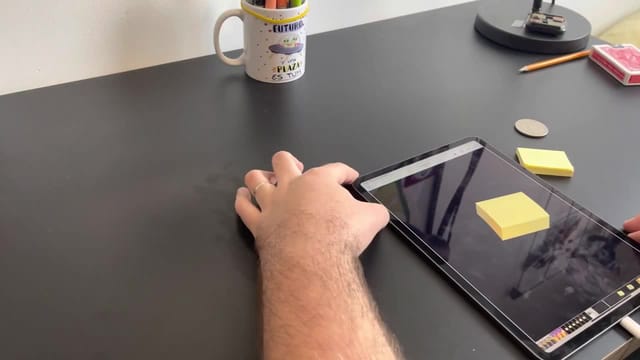
Sticky Note, Coin, and Banknote in a 3D Illusion
Objects Moving from Screen to Hand
A sticky note pad appears to rest on top of a tablet. The hand takes it, places it back into the image, and the sequence continues with a coin and a banknote, blending physical props with their video representations. Julio Montoro explains the choreography that matches each production, vanish, and transformation with the performer's gesture.
The routine is designed to be filmed from a specific angle. The image perspective and framing are part of the effect: it is not presented as a routine meant to be viewed freely from any angle in a room.
Support Video and Screen Size
You will need the 3D perspective video referenced by Julio in the recording, loaded onto your playback device. The explanation focuses on how to work with it and the handling that turns the image into a magical sequence.
The file was designed for an 11-inch iPad Pro screen size. Julio specifies this model and mentions that other tablets of an equivalent size can be used. For a different tablet or a phone, you may need to rescale the video or prepare a custom version suited to its screen; there is no guarantee it will fit every device without adjustments.
The recording refers to a video hosted on YouTube as starting material. This does not include an editing course or instructions on creating a brand-new file adapted to every screen.
Perspective, Reflections, and Framing
The tutorial begins by finding the angle from which the image reads as a volumetric sticky note pad. Julio uses a smartphone to demonstrate how the appearance changes once that viewpoint is found.
Screen reflections are also covered. Adjustments to what the glass reflects are suggested—using a dark area or a white section of the wall—and it is shown why a stray light or reflected object can ruin the illusion.
Framing is also used to stage the props off-camera and access them in the required order. The hands must move through the designated areas without covering or touching parts of the screen that would give away the perspective.
Materials and Sequence Breakdown
The routine uses a small sticky note pad, a one-dollar coin, and a 10-euro banknote, alongside the tablet with the video and a camera for recording. These are the props corresponding to the explained sequence; substituting them may require adapting their representation in the image.
Since Julio does not have the 10-euro banknote on hand during the explanation, he represents it with a large, marked, and folded note. He thus distinguishes the actual routine prop from the substitute used to teach the handling.
The tutorial explains how to display and remove the pad, keep it concealed while the video continues, introduce the coin, and synchronize its contact and sound with the video. Next, it covers the hand action accompanying the transformation into a banknote and the retrieval of the real object as it vanishes from the screen.
The finale returns to the sticky note pad. Julio reviews the linked sequence and points out the position of the banknote and the hand to maintain cover. Palming, off-screen loads, and the timing of each gesture must be rehearsed in sync with the playback.
What You Will Learn to Coordinate
The lesson teaches the handling of this specific illusion: camera position, three-dimensional appearance, reflections, prop layout, hand actions, and synchronization with the media file. It does not require purchasing a commercial magic trick.
It is suitable if you want to work on a visual video piece and can set up the device, framing, and props. The explanation suggests recording yourself to check the choreography, even if you do not publish the take. Its scope is strictly for camera performance; the recording itself warns about the perspective restrictions that would prevent simply transferring it to a live performance without adjusting the viewing conditions.