Open Prediction with a Cutout Revelation
A prediction that ends up turned into a souvenir
Montoro shows a card as a prediction before the spectator chooses one. When it seems not to match the selection, the routine takes a new turn: a shake makes the chosen value and suit appear cut out into the card. The resulting piece can be handed out as a souvenir after the explained cleanup.
The lesson uses the idea of a prediction shown from the beginning and combines it with a visual transformation. The result is a card with a cutout revelation, not an ordinary card whose identity simply changes. The tutorial covers the crafting of the flap, the handling, and two routines for the same construction.
Preparing the revelation and the flap
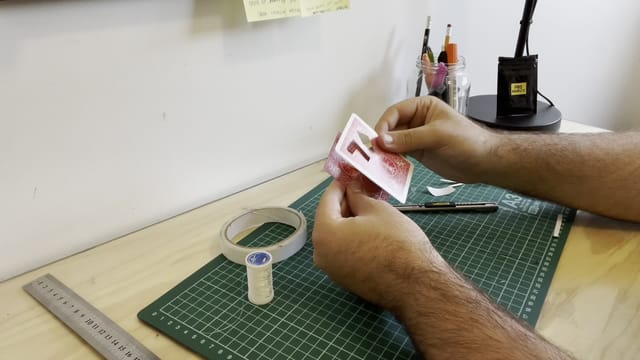
The construction uses two cards, double-sided tape, elastic thread, a needle, a ruler, and a craft knife; scissors and a pencil or marker are also used to trace the design. A deck of cards is needed for the routine. It explains how to draw and cut out the value and suit, keeping the removed pieces if you want to use them in the presentation.
Montoro works on the size of the drawing so the material remains usable, the trimming of the margins, and the folding of the card. The explanation continues with the holes, the thread, and the assembly of the moving part. The ruler and craft knife make it easy to follow the construction; an alternative cutting tool is mentioned for anyone who already owns one.
A lock using a slight bend is also explained to keep the flap set until the moment of performance. Montoro shows the necessary position for the assembly and discusses the angle from which it must be presented. It is wise to check both the mechanics and the appearance of the assembly itself before incorporating it into the routine.
Two developed routines
The first sequence incorporates a force and a Double Lift: it seems the chosen card has risen, a card that doesn't match is shown, and that situation leads into the visual cutout revelation. Montoro explains the connection between the apparent mistake and the shift in presentation.
The second is the open prediction from the demonstration. A prediction is shown at the start, set aside, and then the selection is guided. The mismatch is used as a justification to transform the prediction into a revelation of the chosen value and suit.
The tutorial shows a riffle force and mentions the Classic Force as an alternative. The condition is to obtain the necessary selection for the prepared revelation; a truly free choice of any card is not promised. It is helpful to be fluent in or practice those handlings, because the class focuses on the construction and the transitions of the effect.
Flying cutouts and final giveaway
As a visual touch, it teaches how to load the small cutouts so they pop out when the gimmick is activated. That ejection reinforces the impression that the value and suit have just been cut out. It is an optional feature explained: the routine can also be performed without using those tiny pieces.
After the change, it shows how to remove the part that must be concealed and hand out the souvenir card. The possibility of examination corresponds to the final result after that cleanup. Montoro also warns that the identities of the cards must make sense if you end up handing out the piece, a detail worth deciding when preparing the routine.
An idea with two selections is also mentioned, based on the values from the example. It is an additional application of the principle; the two previous sequences are the routines developed throughout the explanation.
Construction and handling work
This lesson is useful if you want to craft a visual card revelation and end up handing out a physical object. It requires preparing the cutout and the flap, adjusting the elastic and the lock, and rehearsing the viewing angle, the shake, and the cleanup.
The example works with the Seven of Diamonds, while the cards shown as the prediction vary between the demonstration and the explanation. What must be maintained is the relationship between the guided selection, the cutout design, and the card that is handed out. The tutorial provides the walkthrough to understand those conditions and practice the complete assembly.