Workshop on Gimmicks and Card Routines


Julio Ribera teaches card splitting and Hole Matrix; Yago Turia develops two apparent strength effects and Scratch & Win. Four lessons featuring construction, preparation, and routine handling.
Workshop on Gimmicks and Card Routines
Julio Ribera teaches card splitting and Hole Matrix; Yago Turia develops two apparent strength effects and Scratch & Win. Four lessons featuring construction, preparation, and routine handling.
4 Lessons
This path brings together four lessons and ten videos on card preparation and its application to visual effects. Julio Ribera teaches the first two lessons; Yago Turia, who introduces himself as Yago Illusionist, teaches the next two.
The work combines construction techniques with specific routines. Materials and prior knowledge vary: splitting cards is a workshop preparation, while the subsequent effects add handling, misdirection, and spectator participation.
The four lessons, in order
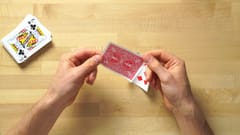
- Splitting Cards. A tutorial by Julio Ribera on card structure, layer selection, separation, and recombination via gluing and drying under weight. Applications for double-facers and double-backers are shown, and other possibilities are discussed without presenting a full routine for each.
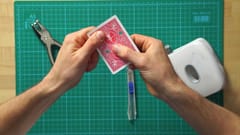
- Hole Matrix. An extensive video by Julio includes a demonstration, fabrication, and explanation of a two-hole routine where the holes change position and end up traveling to a signed card. The design of the working card, the functions of the hole punches, deck organization, selection, signature, and examinable finale are studied.
- The Strongest Magician. Yago teaches two versions, each with a performance and tutorial. One simulates cutting a card with a strike of your hand, and the other has your finger pierce right through it. Preparations, the top shot, cover, and the appropriate moment of misdirection for the second version are covered.
- Scratch & Win. Yago's introduction, preparation, performance, and explanation. A scratch-off sticker reveals the value of a card, and the finale shows that the prediction card itself is the chosen and signed one. Hindu shuffle and force, palm, and double lift are applied within this sequence.
Materials and Preparation
To split cards, you need multi-ply paper cards, adhesive, and a flat finish; Julio uses Bicycle and explains why some cheap, single-ply cards do not work for this procedure. Hole Matrix adds prepared cards, a duplicate, a marker, a hole punch, a utility knife, and a protected surface.
Yago's effects require the card preparations or pieces shown. Scratch & Win also uses contrasting-back cards and scratch-off stickers. Gimmicks are prepared or constructed within the explanations; no branded commercial magic product is required.
Knowledge and Practice
Hole Matrix presupposes an appropriate force and fluency with a break; detailed explanations of various forces are referred to other materials. The Strongest Magician requires knowing the top shot. Scratch & Win applies several techniques and develops their handling within the routine, without becoming a general course on each one.
Yago warns of his left-handedness so you can adapt the hand placement. In his effects, it is also important to practice the posture, lapping, or pocket conditions that are explained, depending on the version.
You can study each lesson separately. Work on the necessary material and techniques first; then the transitions, presentation, and spectator verifications. The ideas and variants mentioned are kept distinct from the routines actually developed.