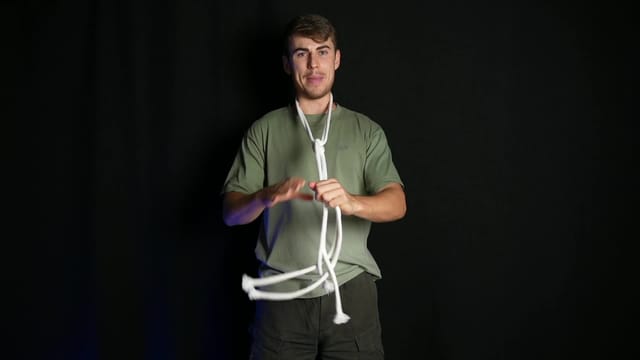
The Prisoner's Escape: apparent release with two ropes
Two ropes are shown and can be handed out for examination. Afterward, they appear to be tied around the neck and an impossible release takes place, retaining a final picture where the ropes and knots are seen.
Julio Ribera includes a performance and an explanation of The Prisoner's Escape. The effect is built with a rope arrangement and a handling tailored for that presentation.
Display and Setup
The tutorial covers how to arrange the ropes while showing them. Hand coordination, gaze direction, and the cover for a wide movement are studied.
Julio explains the arrangement of the centers and how to maintain it during the placement. He repeats the sequence with references to what must be seen from the front, in order to connect the technical explanation with the appearance perceived by the audience.
From the Knotting to the Release
You are taught how to control the handling until the chosen moment to produce the effect. The explanation pays attention to recognizing the change in state of the ropes and to keeping a clear picture during the transition.
The knotting is part of that visual construction. The tutorial shows the organization of the ends and the coordination required for the release to end with the ropes presented in a readable way.
Julio also compares different directions for the final move and explains how one of them can leave a more confusing picture. The goal of that comparison is for the result to be understood, with the ropes and knots visible, rather than turning it into a messy movement.
The explanation finishes with a review of the entire sequence: display, setup during the handling, placement, knotting, and final presentation. The props can be handed out for examination.
What You Need and What to Practice
You need two ordinary ropes of the same length. Julio suggests working with ropes of about two or three meters each, depending on the performance conditions. No apparatus or branded magic product is required.
Practice organizing and displaying the ropes first; then, the transitions and the final picture. Both coordination and the perception of the state of the props during the handling are worked on.
The routine taught is a rope release illusion. Its method and presentation are what this explanation develops; the theatrical performance is part of that context.