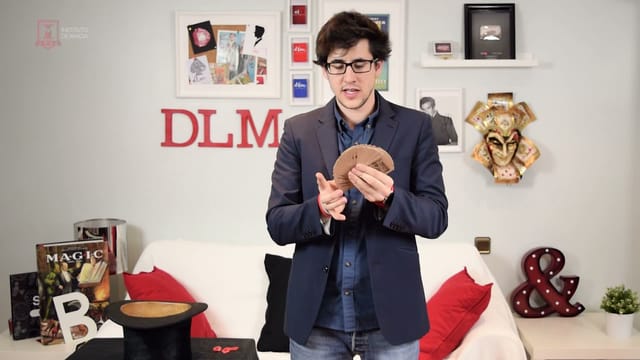
Cardini Production and Card Fans
Two productions for a manipulation routine
Borja Montón teaches the single card production known as the Cardini production and the continuous production of fans. He then combines both resources into a stage routine, using a transformation of the cards into confetti as a transition.
The Cardini production is first studied with a small number of cards. Finger coordination, pressure, and the recovery of the position after each appearance are reviewed. Common issues are also shown, such as two cards coming out together or the packet misaligning, along with ways to recover continuity.
The fan section covers their appearance, the action of discarding them, and their reappearance. Two ways of performing the sequence are compared, and the details that prevent a card from getting stuck out of place are explained. Working with angles, hand span, and coordination ensures the clear visual impact of each production.
Linking the effects and pacing them
The explanation covers the distribution of the props, the loads, and the organization of both hands. It explores how to transition from fans to individual cards, when to square up the packet, and how to set up the confetti transition.
The routine is reviewed phase by phase and at performance tempo. It discusses how many repetitions can be useful before changing effects, how to introduce a pause after the initial appearances, and how to make the cards look like they are being plucked from the air. Alternatives for finishing when only a few cards remain are also shown.
Cards, props, and preparation
You can start practicing with standard cards and a small packet. For the complete sequence, manipulation decks are compared, and bridge-sized cards are recommended, especially for smaller hands. It analyzes how card wear affects grip and sliding, and mentions fan powder as a maintenance supply.
The preparation shown uses a butterfly card holder, confetti, a hair grip, and a safety pin. You can use commercial confetti or make your own with paper. The clothing can be a jacket, a coat, or an open hoodie that allows you to organize the loads. A hat or container makes it easy to gather the cards during rehearsal.
It is helpful to master the one-handed fan and know the back and front production before following the explanation. Coordinating each production requires steady practice: work on the appearances and the fans separately first, and then integrate them with the loads, pauses, and the transition. Clothing choices and presentation can be tailored to the magician's style.