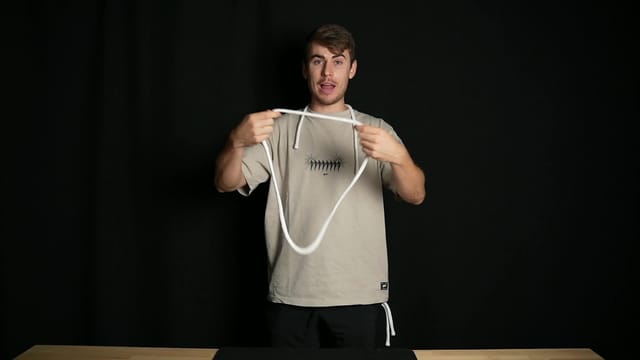
Professor's Nightmare: Removing and Returning the Ends
The ends appear to detach from a rope and become separated from it. After showing them separately, the magician returns them and restores the situation, allowing the routine to continue. Julio Ribera presents this variation of the Professor's Nightmare and explains its two phases: removing the ends and restoring the rope.
Starting Position
The instruction begins with a handling already set up using one short and one long rope. Julio connects this entry to the Professor's Nightmare, following the equalization of the ropes and a joining phase. He also notes that it can fit into another routine that reaches the same position.
Therefore, you should know the basics of the Professor's Nightmare or control an equivalent entry. The explanation does not reteach the entire classic routine from scratch or every display of the three ropes; it focuses on this expansion and the return to a useful position to continue.
Simulating the Knot and Separating the Ends
The first phase develops the gesture that simulates forming a knot and allows the ends to be presented separately. Julio compares the action to tying a real knot so that the movement maintains the same appearance.
Work is done on adjusting the lengths, changing grips, and timing the exchange. Continuity is especially important: the points of support must be prepared so that no extra end appears during the transition. The explanation repeats the path and shows it from another angle to clarify hand placement.
Next, it covers how to slide the figure toward the end and display the separation. The option of momentarily putting the ends in your pocket before moving on to the recovery is also included.
Returning Them to the Rope
The second phase goes through the upward movement that brings the ends back together with the rope. The tutorial details how the path, grip change, and release relate to one another until the restoration is complete.
Julio revisits the points of support and finger coordination, separating the explanation from the rhythm the action should have during performance. The conclusion returns a situation that can be incorporated into the continuation of the base routine.
Naturalness and Practice
An important part of the work is ensuring both hands move symmetrically, at a consistent height, and with the rope hanging loosely. Reviewing the result in a mirror is recommended to evaluate the continuity of the gesture, not just the final position.
The performance does not need to repeat the displays as many times as the tutorial does: Julio distinguishes between the repetitions he uses for teaching and the ones suitable for an audience. The lesson provides a specific phase, its recovery, and those performance details. Regular unprepared ropes are used; no magnetic commercial prop is required for this variation.