Punctuation Marks: Language and Directing Attention
A question, a pause, or a change in voice can alter how the spectator interprets what is happening. Dani Daortiz develops this idea using punctuation marks, a model with which he analyzes verbal and body communication during magic.
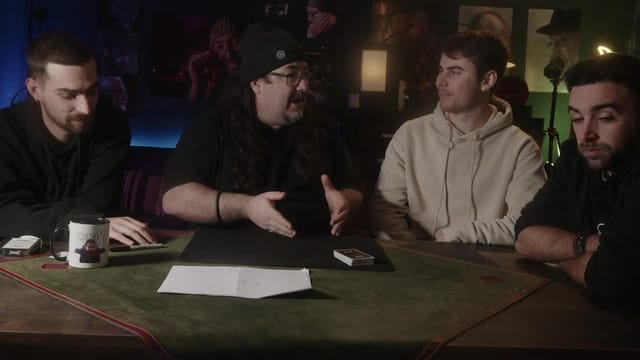
The lesson combines theoretical explanation and practical examples with cards. The core of the teaching is to understand the function of these devices and recognize them in a presentation, rather than treating them as isolated gestures that always produce the same result.
Guiding the Focus
Dani views attention as something directed toward a point of interest. From that perspective, he discusses misdirection, the difference between looking and registering what is happening, and the role of context and expectation.
The shoe test appears as an experiment he describes to illustrate that idea; he clarifies that he is not performing it at that moment because it would require more people. The explanation continues with examples that he does show with the participants and the deck.
Exclamation, Question Mark, and Ellipsis
Exclamations and questions are presented as devices that demand a response. Dani explains that they can be expressed with words, but also with a gaze, a gesture, or the movement of an object.
Ellipses relate to an action that leaves further information pending. The content uses choice and force examples to study how an instruction, a condition, and communicative continuity combine.
The melody of the voice is also worked on: the way of asking, interrupting, announcing, or leaving a sentence open influences how the action is received.
Parentheses, Comma, and Period
Parentheses are explained as a clarification that shifts the moment's interest. The examples relate a lowered voice or verbal precision to the attention that information receives.
The comma represents a pause between phases of a routine that continues; the period, the feeling that the effect has concluded. Dani shows how these moments modify expectation and allow the study of linking and setup actions.
The final period is placed at the close of the session. Punctuation functions here as a presentation analogy, not as a list of mandatory moves.
Applications with Cards and Participants
The explanation uses card forces and group-of-cards forces, packet choices, shuffles, and simultaneous actions by multiple spectators. It studies how to deliver a primary message amidst this multi-information and how to relate it to open door and closing door.
Another segment analyzes the difference that can be perceived between a chosen card and a thought-of card. Dani dwells on language and the memory of the choice, distinguishing what actually happens from the way it is presented and reconstructed.
These examples illustrate the communication model. The lesson does not contain the complete explanation of every routine or technique mentioned during the talk.
Continuity and Apparent Naturalness
Dani relates continuity to the need for the patter and action to continue making sense after a technical moment. The gaze, the distance to the table, posture, and the coming together of the hands appear as parts of that communication.
He also distinguishes feeling natural from conveying an appearance of naturalness. The examples show how a bodily position and an action can prepare the interpretation of the next one, and why it is worth studying the complete sequence.
An Observation Exercise
At the end, he suggests reviewing performances and identifying where the punctuation marks, pillars, and shifts in attention appear. It is an invitation to apply analysis to what is seen, without expecting every gesture to be re-explained in every routine.
You can work through the examples with a deck and participants when practicing interaction. Knowing concepts like pillars, expectation, and multi-information makes it easier to follow the presentation. The content requires observing, rehearsing, and testing communication in front of people; his examples are presented within Dani's magical conception, without guaranteeing an identical result with every spectator.