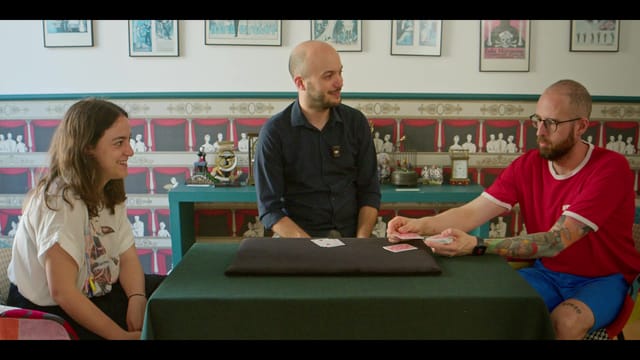
Quadruple Gemini Twins: Four Matches and Presentation Construction
Four cards are set aside as predictions. The spectator deals through the deck and stops at various moments, leading to a revelation of four matching pairs. Eloy Fernández presents his take on Gemini Twins and explains how he weaves the core principle of the trick together with the construction of the scene.
The lesson features a full performance and an in-depth tutorial. Beyond the mere mechanics, it analyzes why he chooses a presentation centered on chance, causality, and premonitions, and how this narrative serves both internal and external functions relative to the method.
Preparing the Four Matches
The explanation revisits Karl Fulves's Gemini Twins as the foundation for two of the matches, utilizing natural duplicates to achieve the others. Eloy demonstrates the setup he prefers to have ready in advance, along with how he selects and separates the cards for his performance.
The initial assembly and the way the predictions are extracted are integral parts of the handling. While it's noted that this could be set up on the fly during another action, the tutorial primarily focuses on the prior arrangement used by the instructor; it does not advocate handing out a truly shuffled deck with zero preparation.
Leaving the Dealing to the Spectator
One of the key structural decisions is letting the participant handle the dealing phase. Eloy explains how he leaves the material set up before handing it over, and what happens as the cards are dealt and the predictions are placed.
The dealing process requires specific durations and card spacing that the patter helps to manage. The apparent freedom and engagement of the participant are carefully balanced against these methodological constraints.
The spread and final extraction are handled by the magician. The lesson differentiates this management from the spectator's phase, ensuring the entire routine isn't framed as something that happens completely without the performer's active intervention.
Using the Blink as Part of the Narrative
In the performance, he suggests stopping the deal whenever the spectator blinks. Eloy analyzes this instruction for several reasons: it helps pace the length of the deal, creates a shared interactive moment with the audience, and ties the spectator's choices directly into the theme of premonitions.
The notion of an unconscious cue is all part of the fiction built into the trick. The tutorial examines how this narrative is constructed and experienced, rather than presenting it as a genuine demonstration of paranormal abilities or a validated psychological procedure.
He also discusses how to handle situations where the deal doesn't turn out quite as expected, and highlights the importance of listening to the participant's feedback when introducing the theme.
Separating the Procedure from the Revelation
Eloy places special emphasis on the forgetting interval and the recap before revealing the matches. The analysis shows how this pause links the presentation back to the memory of what just occurred, perfectly setting up the moment of revelation.
The explanation covers how to display the pairs and how to give certain cards more theatrical weight than others. Thus, the principle of natural duplicates is cleverly linked to language, attention, and the ultimate structural design of the effect.
What You Need and What Is Studied
You will need an ordinary deck of cards, the explained setup, and a table or close-up pad for the deals. There is no need to purchase any specific magic props or the books referenced when discussing alternate versions.
It helps to be familiar with the concept of homonymous cards and to be able to follow a basic deck stack. The lesson thoroughly explores the procedure and its construction rationale; the references to other versions provide broader context rather than full explanations of those handlings.
Eloy Fernández is the instructor presenting his own variation inspired by Karl Fulves's Gemini Twins. This learning experience brings together setup, audience participation, timing, fiction, and revelation into a single cohesive routine.