Re-Corner: The Corner Changes Color and Restores
A Color Change on the Torn Corner
A card is signed and one of its corners appears to be torn off. The small piece changes from blue to red and then visually melts back onto the card. Julio Montoro teaches the construction and routine of Re-Corner, from the prepared gimmicks to handing out the signed card at the finish.
The effect centers entirely on the corner. This is not about freely changing the color of the entire deck or impromptu restoration of any card a spectator tears. The routine uses specially crafted pieces for this exact result and sleights that allow you to retain a finish card to hand out as a souvenir.
Gimmicked Card and Moving Corner
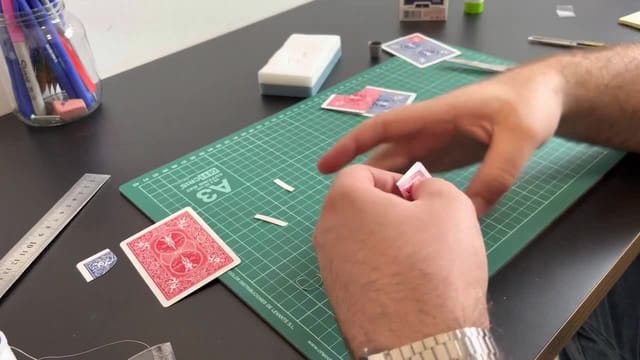
You will need red and blue backed cards, clear tape, double-sided tape, elastic thread, a needle, and scissors. Glue sticks and a permanent marker for the signature are also used. The number of cards needed depends on how efficiently you can use your scrap cuttings and the additional card you prepare for the finale.
First, you construct a card featuring a portion of a different color. Julio cuts and folds the piece, adjusts its placement so it doesn't peek out, and secures it with tape. A small adhesive area keeps it closed; magician's wax is mentioned as an alternative, not a mandatory supply.
Next, you build the color-changing corner. The pieces are trimmed together to match their shape, the white border is attended to, and the colored section that shouldn't be seen before the change is adjusted. The elastic thread is threaded with a needle, knotted, and the excess is trimmed.
The explanation differentiates between moving the gimmick without cover versus activating it during a shake. The construction and hand movements must work in tandem so the transit goes completely unnoticed.
Preparing the Finish Card
Julio also demonstrates how to craft a card that can be shown and handed out at the end. One layer of the corner is separated, trimmed, and the colored finish is glued into the corresponding spot. This preparation must be left to dry.
This souvenir finish card serves a different purpose than the moving gimmicks in the routine. Just because the spectator gets to keep the final result doesn't mean they are handed all the props that produced the transpositions.
Selection, Signature, and Pocket Setup
The explanation uses a well-known card, the Queen of Clubs. The option to force it is discussed, along with the more direct presentation of having that card chosen and signed. The tutorial applies this choice directly to the routine without running a full masterclass on classical forces.
While the signature is being arranged, the prepared card is positioned and the retrieval of the corner from the pocket is set up. Julio refines the pocket positioning during the explanation and suggests keeping that piece open using another marker.
The turns, cover, and Double Lift connecting the signed card to the subsequent phase are all covered. These actions must be practiced in context: merely possessing a gimmick that changes color independently is not enough.
Apparent Tear, Change, and Restoration
You are taught how to mimic tearing the corner—leveraging the proper gesture and sound—and how to display the piece that looks freshly ripped off. A sharp shake releases the moving piece and triggers the color change.
Next, the hand is shown, the corner is removed using the explained sleight, and the deck is recovered to execute the final change. Julio reviews the continuity of these steps and offers ways to retrieve the finish card, including using a Double Lift if you prefer that cover.
The signed card is presented at the conclusion of the sequence and corresponding changes. The construction of the gimmicks alone does not turn any intermediate moment into an examinable situation.
What You Will Learn to Practice
The lesson brings together the fabrication of both gimmick parts and the deliverable result, material placement, selection and signature, pocket retrieval, activation, Palm, final change, and a routine recap.
This is ideal if you want to work on a corner effect featuring construction and card handling. The Double Lift, cover, and Palm are all part of the necessary practice. The cards and materials are prepared right inside the tutorial; no need to purchase a commercial magic product to follow along.