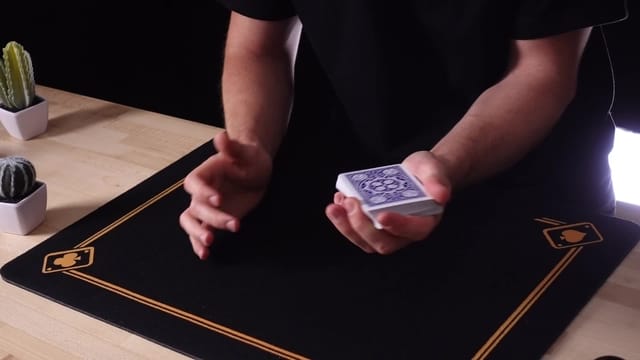
Riffle force: break and continuity of movement
The spectator indicates when to stop the riffle and appears to choose a card from that point in the deck. Julio Ribera explains the sleight that allows you to offer a prepared selection within that action.
The lesson demonstrates the force, breaks it down, and recaps it to study the relationship between the break, the separation of the packets, and the delivery of the card.
Setting up the card and the break
Julio uses a Swing Cut and a pinky break to establish the reference for the sleight. You will study how to maintain it while keeping the deck looking squared.
The card used in the examples makes it easy to follow the explanation; the procedure can be applied to any other prepared selection. The instruction focuses on the force, without adding a full prediction or mentalism routine.
Coordinating the riffle and the hands
The tutorial covers the supporting grip, the thumb riffle, and the intervention of the other hand when the participant says stop.
Julio pays attention to finger work and the moment to release the visible opening. The idea is for the actions to flow into a natural movement rather than feeling like separate steps.
You will learn which details to watch for during practice and how to connect the front-facing gesture with the reference held during the selection.
Continuity up to the selection
The explanation revisits the movement at normal speed and repeats it to examine the subtleties. The result depends on coordination: the spectator sees an interruption and a card delivery that must maintain the same visual logic.
Julio recommends studying the cleanliness of the sleight and observing its application in performances. This reference adds no videos or links other than those included in this lesson.
Materials and technical preparation
You need a standard deck of cards. No gimmicks or commercial magic products are required.
It helps to be familiar with the Swing Cut and the break; here you will see how to use and maintain them within the riffle force. Practice two-handed continuity and card release before incorporating the technique into a routine.
Julio Ribera is the instructor. The lesson teaches a seeming-choice method, without promising universal invisibility or a result independent of your execution.