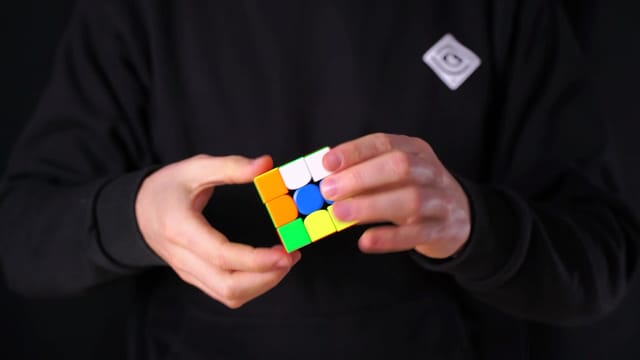
Rubik's Cube False Shuffle
What Most People Get Wrong
Most people try to learn complicated algorithms to solve a Rubik's cube from a truly mixed state. When you're performing, you don't need to know how to solve a scrambled cube; you just need to know how to make it look like you're scrambling it while keeping the cube in a state you can control.
Why It Matters
When you stop worrying about solving the cube, you can focus on the performance. By using a false shuffle and a specific four-move sequence, you create the illusion of chaos while keeping the cube under your command. This lets you "solve" it in a heartbeat, which is much more visual and impressive for your friends than spending minutes twisting faces.
What You'll Learn
You'll learn how to display the cube as scrambled by performing a set of moves that look random but are actually reversible. We cover the specific finger placements—using your index, middle, and ring fingers—to rotate the cube fluidly. You’ll also learn a false shuffle that keeps the pieces in place while appearing to mix them thoroughly.
The goal is to turn this into muscle memory. You'll practice these moves in a continuous flow so there's no pausing or hesitation, which is exactly where the magic happens.
About the Instructor
Julio Ribera is a Spanish magician who specializes in making magic accessible. He’s been creating digital magic content for years and focuses on teaching practical techniques that you can use to create real moments of wonder without needing years of practice.
What's Included
- The four-move sequence for "un-solving" the cube
- Finger positioning for smooth, continuous rotations
- The mechanics of a convincing false shuffle
- Tips for building muscle memory
- How to combine moves for a fluid performance
Frequently Asked Questions
Do I need to know how to solve a cube normally?
Nope. This is a magic trick, not a puzzle-solving tutorial. You only need to learn these specific moves.
How do I know if I'm doing it right?
The best way to tell is to watch your own hands. If you see yourself pausing or stopping between movements, keep practicing until it's one smooth, continuous motion. It should look like you’re just turning the cube casually.
What if I mess up the shuffle?
Since the method relies on a set sequence, if you lose your place, just stop and reset. Because you’re only moving a few pieces at a time, it’s easy to catch your breath and start the sequence over.