Shadow You: Touching the shadow to move the cellophane
An action on the shadow affects the object
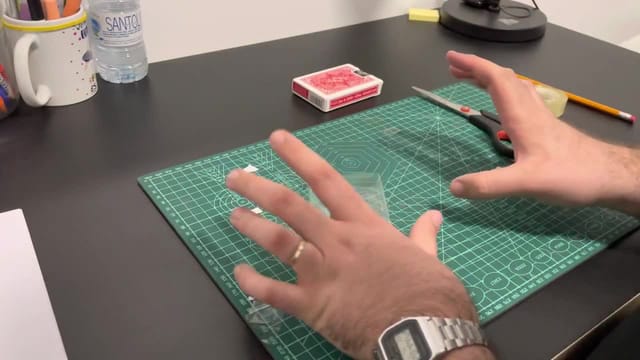
The shadow of a deck of cards with its cellophane wrapper protruding is projected onto a wall. The magician or spectator touches the cellophane shadow downwards, and simultaneously, the real cellophane moves down. Julio Montoro explains the preparation and coordination required to present this relationship between the projected image and the object.
The routine uses a small staging setup involving light and shadow. The participant can perform the gesture on the wall, but the effect still relies on the magician's action with the gimmick; it is not an object that reacts automatically to the spectator's touch.
Materials and preparation
You will need a deck of cards, two deck cellophane wrappers, scissors, and adhesive tape. A strip is cut from one of the wrappers and attached to the other to create the sliding mechanism.
Julio shows the already constructed gimmick and explains its assembly and the retention crimp; he does not rebuild the entire thing live. The explanation covers how to position the cellophane at the top, hold it, and pull so that it folds or lowers at the chosen moment.
Light, wall, and viewpoint
The performance requires a smooth wall and a light source that casts a clear shadow. Julio suggests using a phone flashlight held by the participant and clarifies that total darkness is not necessary, though sufficient contrast is needed to see the shadow.
The recording's demonstration is done using a desk lamp, and the instructor himself notes that it does not favor the effect as well as the setup he proposes with a mobile phone. Distance and orientation are arranged so that both the shadow and the actual cellophane are visible.
It is also pointed out that the strip can be seen from certain angles. The tutorial shows the area that must remain covered; you will need to find the position from which the audience observes the illusion without revealing that preparation.
Timing the movement
The explanation connects the gesture of touching the shadow with the action of lowering the cellophane. That timing is the core of the presentation: the change in the object must be perceived as a consequence of what just happened on the wall.
At the end, it is suggested to add a thumb tip to complete the appearance of visible fingers. This is an additional idea mentioned, not a variant whose construction is detailed, nor an obligatory product to perform the main setup.
Scope of the lesson
Julio mentions Penn & Teller's rose and Tobias Dostal's Silhouette as sources of inspiration. Their methods are not taught, nor is it necessary to purchase those effects to follow this preparation.
The lesson explains a brief setup and its application with a shadow, not a complete repertoire of lighting magic. It is useful if you want to work on a visual illusion with a simple prop and can control the light, background, angle, and timing of the gesture. The simplicity of the construction does not eliminate those performance conditions.