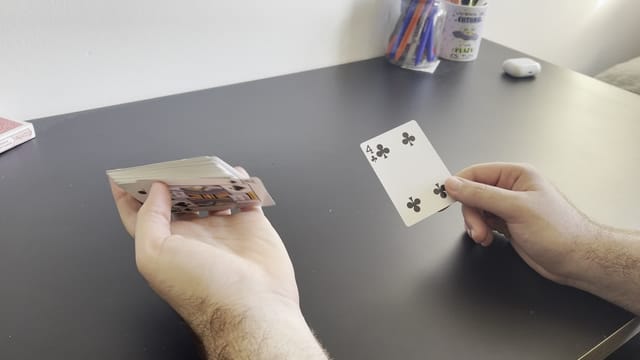
Solapa Color Change
A card change performed by hand
Julio Montoro teaches a visual change in which the card shown above the deck becomes the selection. He calls it the flap-finger principle because finger retention permits the movement; it is not a cardboard flap construction or a purchased gimmicked card.
During the explanation he also develops a transposition application: the selection appears on top and the previously visible card ends reversed in the deck. It is a tested use of the same movement, demonstrated again as a possibility.
The essential viewing position
The change is intended for a camera or a person beside the magician's shoulder, in the position indicated. Julio stresses that it cannot be watched surrounded or from arbitrary angles. The particular viewpoint covers the fingers and extra card.
The lesson connects camera placement with what the spectator sees and what happens behind that image. It suits someone willing to use that framing or observing position, rather than offering a frontal show for a surrounding group.
Retention, action and motivation
The tutorial starts from a double lift and pinky break to manage the two cards. Julio shows the index-finger placement, retention of one card and lowering of the hand for the change. A thumb gesture motivates the action instead of moving without reason.
He also discusses an application when setting down or turning the card and works on removing the extra card. That cleanup needs finger action, turning coordination and practice. A Charlier cut is mentioned as another option, not a requirement for the main change.
Card control and transposition
The initial demonstration shows bringing the selection to the top; another control you already know can be used. The aim is to reach the required position, not replace a complete card-control course.
The later transposition revisits a bottom control and top recovery while shuffling, then the change and a cut that leaves the other card reversed in the middle. Double-lift, break and control practice remain necessary for the sequence.
Materials and scope
You need an ordinary deck and confidence handling two cards as one, holding a break and controlling a selection. No prop construction, adhesives or card modifications are needed. Preparation concerns position and handling, so the impromptu aspect retains its technical and angle conditions.
Montoro says he had not found a similar move when recording and asks for references. This is his proposal and explanation, not independently proven historical originality. The lesson focuses on the change, its motivation, extra-card removal and one application with careful attention to viewpoint.