Working with the Spectator’s Hands
Guiding clear cooperation
This lesson by Xulio Merino brings together introductory advice for performing sponge-ball magic in a spectator’s hand. The video addresses choosing a participant and communicating what you need them to do.
The main context is a simple placement within a brisk sequence. The explanation explores the relationship between the handling and the physical response of the person helping.
Choosing and observing the participant
Xulio suggests listening to and observing the audience during the presentation to recognize a cooperative, expressive attitude. He also discusses how hand size and the person’s attitude influence the choice.
These are criteria for adapting participation. Managing more difficult situations is presented as a later development.
Asking for the hand and demonstrating the gesture
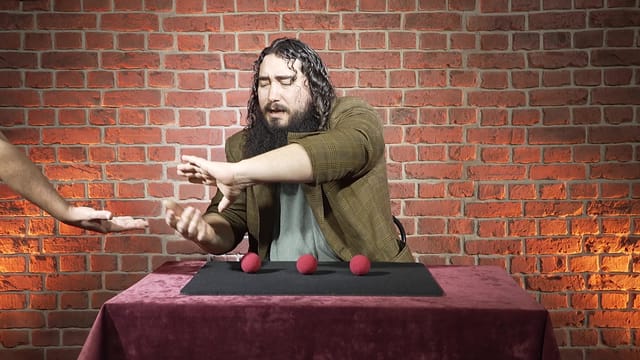
The lesson explains how to indicate which hand you want the spectator to extend and how to accompany your words with a visible position of your own hand.
The chosen orientation takes account of the participant’s thumb and the space the handling requires. The instructor distinguishes placement on the palm from a position on the fingers that may be uncomfortable.
Guiding without struggling
The lesson addresses closing the hand and when to withdraw your own. Xulio emphasizes guidance through instructions and small supporting gestures, keeping physical intervention on the other person’s hand limited.
He also discusses the orientation of the fist and using the table as support. The study covers watching for the participant starting to open their hand and reminding them of the instruction within the presentation.
Application and technical foundation
To practice the application, you need sponge balls, a basic loading technique you already control, and another person’s cooperation. A table lets you reproduce the support Xulio discusses.
The focus is on selecting, asking, placing, and guiding. These are introductory tools for integrating the spectator’s hand comfortably and clearly into a routine, while adapting the presentation to the person helping.