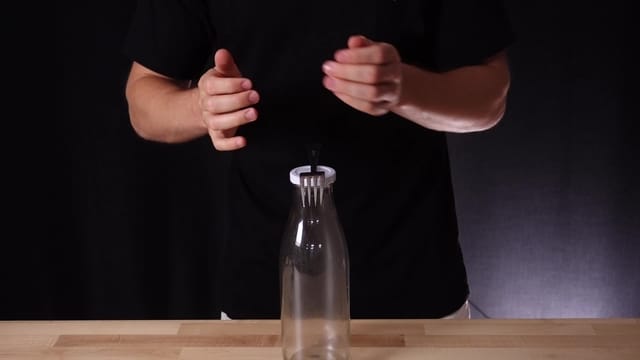
The spinning fork
Julio Ribera teaches you to present a fork that starts spinning without your apparently touching it. The demonstration uses the idea of building up static electricity by rubbing your hands; the tutorial explains the magical loop handling that produces the animation.
The lesson contains a demonstration and an explanation. Julio presents it as an effect for a table setting, such as a meal with friends, and develops different ways of supporting and handling the object.
Two ways to support the fork
The explanation shows the fork balanced on a bottle or container and also a presentation directly on the table. You will learn to position the object, prepare your hands and check what each support needs to allow the rotation.
The weight of the cutlery and the surface are important: a smooth table makes movement easier, while a rough surface can offer too much resistance and strain the material. A bottle is not required for every variation, although it lets you present the fork raised on a support.
Handling, presentation and ending
Julio uses the action of rubbing his hands to incorporate the setup into the presentation. He then explains how to start and accompany the rotation, what to adjust when the fork's weight makes movement difficult and how to coordinate your hands during the animation.
The tutorial includes different approaches to the object and teaches the ending in both the container and tabletop versions. It covers finishing without having to touch the fork again, so the spectator can pick it up and examine it.
What you need
You will need an elastic thread loop and a fork; the explanation also mentions a spoon as an alternative piece of cutlery. If you choose the raised version, add a bottle or container on which it can balance. For the tabletop version, first check that the surface and the object's weight allow the movement Julio teaches.