Super Gluefinger: A Corner Fuses with the Signed Card
A Signed Corner Becomes a Keepsake
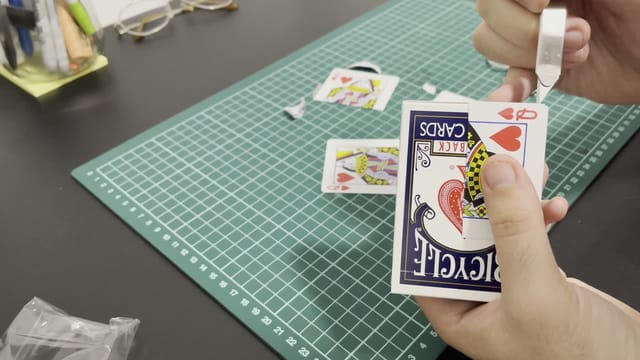
Super Gluefinger features a card whose corner appears to fold during the routine. The spectator participates by pressing the fold and signing the card; then they rub their fingers as if they had Super Glue on them and discover that the corner has become permanently integrated into the object.
Julio Montoro teaches the manufacture of the gaff card and the preparation of the tuck box that allows this participation to unfold. The result is a signed souvenir with a fused corner, not a standard card restored to its original shape. The name Super Gluefinger is the patter presentation; the construction materials are worked on before performing.
Cards and Preparation Materials
The example uses two identical cards, obtained from two decks, a deck for the routine, and one of its tuck boxes. Glue stick, double-sided tape, adhesive tape, scissors, a utility knife, and a permanent marker for the signature are also needed. Matte tape is recommended to better conceal the tuck box assembly.
Montoro discusses the possibility of using a force deck to manufacture many identical pieces. It is an option for producing spares, not a mandatory product to learn this construction.
The class covers cutting the corner, preparing the cardboard layers, and integrating the piece. It also shows an optional thickness adjustment to achieve a finer finish. Afterward, the card is left to dry and pressing it between books is suggested while working on the other part of the assembly.
Preparing the Tuck Box for Participation
The second part builds the tuck box gimmick. It explains how to prepare the auxiliary piece, apply the tape, and leave the necessary space for the card to slide. Two layouts are compared, including the one that allows showing and pressing the folded corner during the presentation.
The tutorial pays attention to thickness, corners, and excess tape. These are details that affect the subsequent movement of the card and the overall appearance; it is advisable to check them with the actual material before practicing the routine.
Selection, Fold, and Signature
The working card is prepared, so the selection is directed to it. Montoro explains how to locate it by the cutout, maintain a pinky break, and use a classic force. The explanation integrates these sleights into the routine, without promising an arbitrary selection from a borrowed deck.
Next, the orientation of the card, the coverage of the corner, and the transition when returning the deck to the tuck box are reviewed. The placement allows presenting the fold and asking the spectator to press it, maintaining the support and hold required by the handling.
The signature is made in the area indicated during that sequence. The spectator's participation is part of the effect, but it is guided within the explained positions: the assembly is not handed out uncontrolled before the finale.
Extraction and Revelation of the Souvenir
Montoro demonstrates the extraction of the card, how to continue the folding gesture, and the positioning so the spectator can rub their fingers. That patter gives meaning to the apparent fusion and directs attention to the change that will be revealed.
Upon finishing, the signed card with the integrated corner can be handed out. The tuck box and its gimmick remain available to prepare another presentation, while the signed object is the keepsake the spectator takes home. The class allows following the path to that giveaway and distinguishing the working material from the souvenir.
Preparation and Rehearsal
This is a lesson for anyone wishing to craft an impossible card object and build an interactive presentation around the signature and the fold. It requires preparing and drying the gaff, adjusting the tuck box, and practicing the force, cover movements, entry, and extraction.
The effect is performed with the deck, the prepared tuck box, and the marker; it requires that prior preparation. The tutorial develops a complete routine supported by the assembly, with construction options that help understand why the version with spectator participation is presented in that manner.