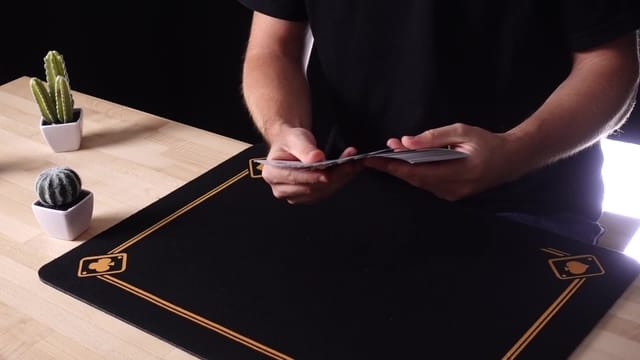
Swing Cut Force
A card that appears to mark the selection
A spectator inserts a face-up indicator card while the magician offers cards. Julio Ribera uses the Ace of Spades as a visual arrow, but another ordinary card can fulfil the role. The lesson explains the preparation and handling behind that apparent choice, not an infallible free insertion.
Preparation and timing
Locate and prepare the intended selection while looking for the indicator card. A Swing Cut and break then support the sequence. The explanation studies obtaining and holding the separation, packet size, riffling and the participant's timing.
If the participant waits too long, continue and renew the instruction before the cards run out. The tutorial does not treat every possible stopping point as equivalent.
Showing and motivating the handling
Grip changes, finger coordination and the display are connected with words about which card is to be divined. These give the actions a purpose. A recap links insertion, display and the card the spectator receives.
You need an ordinary deck; the indicator comes from it and is not a gimmicked card. Familiarity with the Swing Cut, break and riffle is useful because the lesson applies them rather than replacing all their foundational teaching. Practice the coordination and instructions without assuming a guaranteed response.