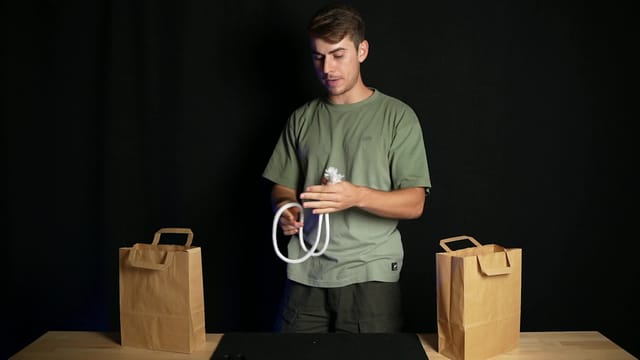
Sympathetic Ropes: Knots, Cut and Restored
Two ropes are introduced separately, each alongside its own container. A knot tied in one appears to magically manifest in the other; when untied, the second one vanishes. Afterward, the cutting and restoration of one rope is reflected in its counterpart. Julio Ribera showcases this sympathetic routine and breaks down the handling that connects its various phases.
Materials and Prerequisites
You work with two ordinary ropes, a pair of scissors, and two containers. You can use bags, boxes, hats, or any other props that serve the purpose. Julio recommends using props that are open, comfortable, and allow a clear view inside: tall, narrow containers make rope management difficult, even though the recorded performance utilizes bags of that type.
The foundation of the first phase is the instant production of multiple knots, adapted here to produce just a single knot. Julio assumes you are already familiar with this technique; this explanation employs and reviews its placement, but it does not replace a comprehensive study of knots. He also revisits the classic handling for the cut and restored rope, walking through it to integrate it seamlessly into the routine.
Preparing the Appearance and Vanish of the Knot
The explanation begins by showing how to arrange each rope when putting it away. The two placements serve different functions: one allows the knot to appear as the rope is pulled out, while the other enables its vanish.
You will learn how to keep the working end accessible and maintain your orientation while showing the props. The setup is built directly into the handling; the key is ensuring that putting away and removing the ropes makes logical sense to the spectator.
Next, the two reactions are linked: the knot appears in the second rope, and when the first knot is undone, its companion vanishes as well. The tutorial reviews the sequence and prepares the grip point to be used in the following phase.
From the Cut to the Reaction of the Other Rope
The second part incorporates the cut and restored sequence. It explains how to present the two pieces, separate them during a natural gesture, and move from one container to the other while maintaining complete control of the props.
Julio focuses closely on the finger palm, the transfer connecting both ropes, and the timing for directing attention to each bag. The learning goes beyond simply knowing two isolated effects: it lies in coordinating these actions so the audience perceives a continuous sympathetic reaction.
Restoration and Closing the Sequence
The routine concludes with the restoration of both ropes. The explanation connects the slip knot, its release, and the final extraction, then walks through the entire routine again to cement the order of actions.
The props used are completely ordinary and can be handed out for examination under the conditions of the explained finale. The cleanliness of the finish depends on completing the sequence and managing your props effectively; it does not replace the technical work happening throughout the routine.
The lesson includes a performance and a tutorial with a recap. Its main value is building a multi-phase routine using ordinary ropes and containers, emphasizing interior access, order memory, transfers, and spectator management.