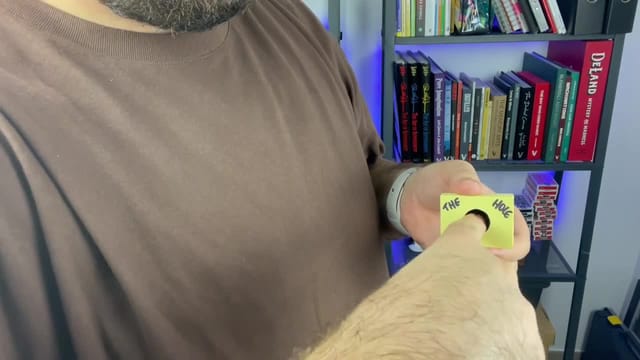
The Hole: A sticker becomes a hole
A hole that opens and closes again
A sticker on a notepad seems to become a real hole. A finger can enter it and a coin can apparently vanish inside. The hole then closes, and a sheet is removed to give to the spectator.
Julio Montoro explains the prepared pad's construction, coin preparation and routine handling. The material comprises a presentation video and an extensive construction/explanation tutorial. Handing out the sheet does not make the whole pad freely examinable: the accessory stays with the magician.
Materials and optional kit
You need two sticky-note pads, thick white card, black felt, magnets, circular stickers, double-sided tape, ordinary tape and a glue stick. Cutting and marking use a craft knife, scissors, ruler and hole punch. The routine also uses two 2-cent coins and a marker.
The tutorial explicitly distinguishes kit materials from obtaining them separately in ordinary shops. Buying the kit is not compulsory. Circular adhesive dots can serve as stickers, and the magnets must fit the prepared holes; a shop mention does not make its materials set the only option.
Black felt belongs to the construction and black-art principle. Julio clarifies that simply substituting black card is not what he means. The prepared coin has that finish on one face and must fit the assembly's size.
Hollowing, rebuilding and drying the pad
Three rigid pieces are prepared to note size, and the centre of one pad is hollowed out. Julio separates small groups of sheets, cuts them and keeps them in order for reassembly.
He shows gluing, squaring and pressing those groups without adhesive where movement must remain possible. The block is then weighted until dry and able to retain its required shape. This is a laborious part of the project, not an accessory made without time or adjustment.
Magnetic pieces and finishing the hole
The three card pieces are punched using one as a guide. Marks preserve orientation, and the magnets are recessed flush so the parts fit. The recording includes placement corrections and renewed checks of the connection.
The base is fixed to the pad, internal magnets added and the hollow lined with felt. The finish must reach the corners and be trimmed without obstructive excess.
A sticker provides the reference for cutting the circle, and the faces are covered with notes. “The Hole” lettering and initials visually integrate the assembly. A felt-backed coin is also prepared using a principle Julio attributes to José Arkadio; mentioning another effect of his does not include that complete method.
Showing, switching and restoring the normal appearance
Handling begins by showing the intended pad faces. While apparently applying a sticker, part of the accessory is removed and switched through palming and a turn, making the hole available.
The explanation repeats the movement and connects the sticking gesture to the covered action. It also teaches the reverse route to close the apparent hole, remove the note and replenish it from the extra pad.
Construction takes more work than the final action, but apparent simplicity does not eliminate practice. Coordinate fingers, palms, turn and displays to avoid exposing the concealed part.
The two-coin routine
One coin is prepared; the spectator may sign the other. Julio explains the prior switch and retention of the real coin, plus the possibility of hiding the prepared one behind the pad before use.
The black-art coin enters the hollow and is retained magnetically. The explanation distinguishes that apparent vanish from the spectator coin's whereabouts. The uniquely signed coin is not promised to remain visible throughout.
The hole is then closed and the sheet handed out. Returning the real coin as well requires retrieving it and making it appear with additional handling. That ending needs recovery, rather than automatic ejection from inside the prop.
What you will learn and prepare
The lesson combines construction, finishing, prepared coin, basic handling, routine and note replenishment. It suits those who enjoy building props and accept time for cuts, magnet alignment, lining and drying.
Practise the palming, switches and cover applied here. Generic materials can be used; even without buying the commercial kit, the effect still requires the built pad and the explained handling conditions.