Three-Die Routine: Changes and Prediction
Three phases with ordinary dice
The routine begins with a die whose spots appear to change. With the introduction of the second die, a brief orientation and perception puzzle is created. The third die allows for a concluding prediction regarding the sum of several faces that remain hidden when the dice are stacked.
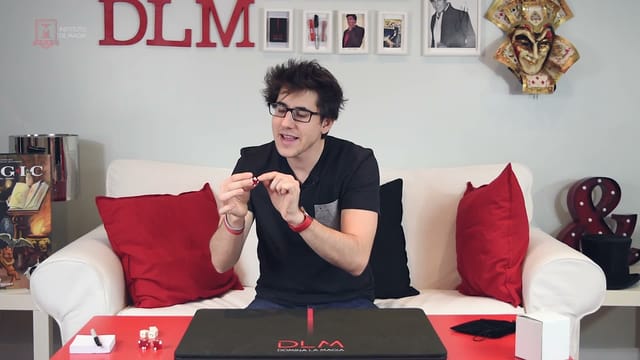
Borja Montón demonstrates the complete sequence and explains each phase separately. The grips, angles, and moves necessary for the visual changes are studied, alongside the transitions that provide continuity as each die is introduced. The middle trick is framed as a brief comedic pause before the finale.
The final phase involves spectator participation, the stacking of the dice, and the verification of the sum. Instructions are given on how to keep the stack stable, how to clarify which faces should be added together, and how to guide the calculation. Both a written prediction revelation and a spoken alternative are shown.
Giving meaning to the sequence
The demonstrated presentation uses a story about Las Vegas and gambling. The explanation suggests ways to adapt this context and analyzes how to present an object as everyday or as having magical properties.
The difference between showing, transforming, and revealing is also explored. Movement, pauses, and misdirection help the audience distinguish each effect. The phase with two dice retains its function as an interluding piece so that the momentary confusion gives way to a clear conclusion.
Choosing the dice and practicing
For the complete routine, you will need three conventional six-sided spotted dice. Small, rounded-edge dice make handling easier; the difficulties of using large, transparent, or sharp-edged dice are discussed. Poker dice are shown as an alternative for the first visual part, without replacing numerical dice for the entire routine.
A stable surface helps when working with the stack. Prepare paper and a pen if you want to use the written finale; the spoken alternative allows you to dispense with them. The initial effects require manual rehearsal and angle sensitivity. For the finale, it is wise to practice the simple math and the way to verify it with the participant.