To Do List: Two Halves That Seem to Melt Together
Julio Montoro presents a to-do list written on an index card. He tears it in half, setting up a torn and restored effect, but the kicker shifts the original premise: the halves appear to have fused into an impossible object that the spectator gets to keep.
The lesson includes the performance, prop building, setup for performing, and handling. It teaches a climax in the spectator's hands and a more visual alternative in the magician's hands.
Manual Construction
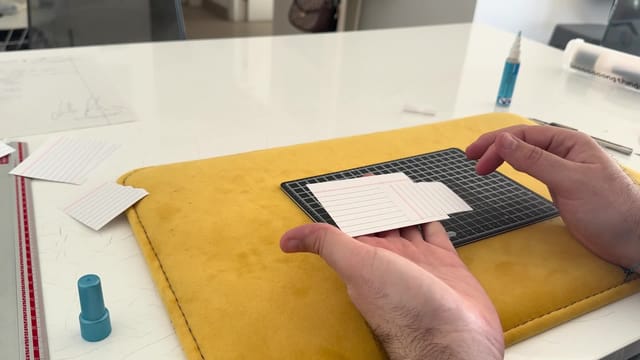
The procedure starts with two cardstock index cards, matching the type used in the explanation. You work on the irregular cut and prepare the layers of one of the pieces.
Julio points out that the index cards in the example have two layers and separating them requires different care than splitting a playing card. The tutorial clearly demonstrates this preparation before joining the parts.
It explains how to square up the gimmick, glue it, and let it dry under pressure. Julio recommends a glue stick for bonding; the repositionable adhesive shown in the footage is not his preferred choice for that finish.
Preparing Multiple Copies
After making the prototype, the tutorial explains how to scan both sides and use them to prepare printed copies. It covers double-sided printing and cutting out the pieces, rather than manually making each copy from scratch.
The printed alternative is based on the prototype you built. The lesson teaches the reproduction process; it does not rely on you receiving a finished commercial design.
This process gives you multiple units, which is useful if you want to hand the final result to the spectator as a souvenir.
Writing and Handling
You learn how to write the list and prepare the two sides involved in the presentation. You can use your own tasks or present it as a shopping list. The written content gives the index card a casual, everyday context.
The handling covers the initial display, the tear, and showing the two halves. Julio explains audience angles and hand coordination during the transitions.
In the interactive climax, the spectator holds the prop in their hands and discovers the fused-looking piece. The visual alternative presents that outcome in the magician's hands. The souvenir retains the appearance of two halves fused into a single piece.
Materials and Practice
For the manual version you need two index cards suitable for the layer work shown, a craft knife, glue, and a pencil or marker appropriate for the medium. Drying is done under pressure; a book is used in the video. For the printed reproduction, you also need the ability to scan and print the prototype.
Julio discusses choosing a writing instrument so the text doesn't bleed through and ruin the setup. The characteristics of the card and ink are part of the gimmick.
You do not need to buy To Do List as a finished product. Practice the construction, drying, and writing first, followed by the display, tear, and transitions to your chosen climax. The prop is carried fully prepared before the performance.