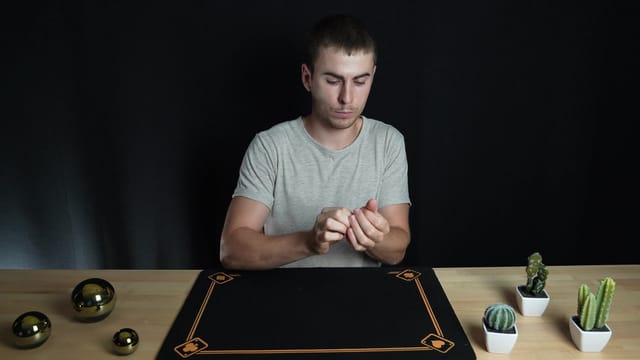
Three Coins: Production, Color Change, and Vanishes
Three coins appear, one changes from copper to silver, and all three vanish in a sleight of hand sequence. Julio Ribera explains the routine as an example of the possibilities offered by the double shell and double-faced coin included in Hopping Half.
Materials and Prerequisites
You need that specific Hopping Half component, featuring its two nestable shells and the double-faced coin. Three ordinary coins or a single shell will not suffice. You can look for the corresponding set at your favorite magic shop, making sure it includes the described pieces.
It is helpful to know finger palm, classic palm, and the French Drop. The instructor reviews their functions and recommends getting used to keeping the coins concealed while performing natural actions, though this does not replace detailed training from scratch in each technique.
Choosing the Production
The explanation compares a slide production with a gravity production. Julio points out that the second one is riskier and distinguishes the visual appeal in a video recording from what is sufficient and convincing in person.
Next, the successive appearance of the three coins is broken down. The orientation of the gimmick, the grips, and the symmetry of both hands are studied to maintain the same appearance when changing how the coins are supported.
Copper-to-Silver Change
The transformation is blended into a moment of misdirection toward the coins already produced. The instructor explains why that timing relies on live performance and how to justify the subsequent repositioning of the pieces.
He also works on the consistency of the hand where the vanishes take place, avoiding having the finale switch sides without a visible reason. These are structural decisions that go hand in hand with how the gimmick works.
Vanishes and Finale
The first vanishes are coordinated with the nesting of the pieces. The last one uses a French Drop and a transition to a classic palm. The genuine action of taking a coin is compared to the technical gesture, and hand coverage during the final actions is examined.
Showing the hands is angle-sensitive and retains a palmed piece: there is no promise of ending completely clean or being able to immediately offer both hands for inspection. The tutorial emphasizes naturalness, gaze direction, and practicing position changes.
This is an advanced routine with several subtleties that are best studied separately before putting the full sequence together.