Sandwich: The Signed Card Travels Between the Jacks
From One Sandwich to Another
A signed card is seemingly placed between two black jacks, vanishes from that group, and reappears between the two red jacks inside the deck. Julio Montoro explains the construction that makes the card visible before the vanish and the handling that prepares its arrival at the other group.
The routine uses the spectator's hand and allows them to spread the deck for the revelation. The pair used to present the vanish includes a gimmick card; this is not a version performed solely with unmodified cards.
Gimmick Construction
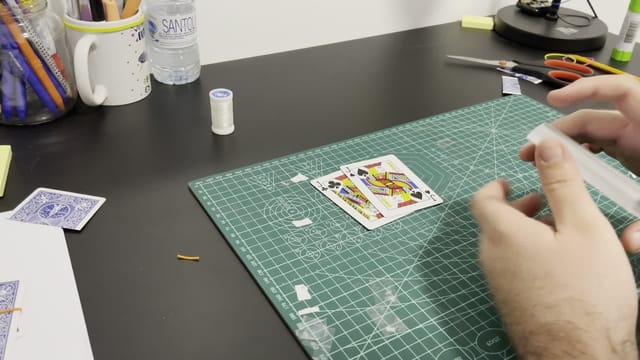
The assembly uses two identical cards and a different one, or three jokers as an alternative mentioned by Julio, plus an extra card to cut a small piece from. The example is later integrated with the black jacks and the two red ones from the deck. You will need the corresponding duplicates, a deck, scissors, and a glue stick or double-sided tape.
The tutorial teaches where to place the cut piece, how to join the cards, and how to square and press the assembly. Drying and alignment affect the handling. The preparation is made during the lesson; it does not require buying a finished gaff deck even though the teacher mentions the idea came to him while working on one.
Preparing the Red Jacks and the Selection
Julio shows the two red jacks together and works the separation with a break and a cut to arrange them as the routine requires. He explains a more covert way to perform that action and offers the direct cut as an alternative.
Then a card is chosen and signed. The explanation relates what the participant does with the displays of the black pair and the orientation the magician must maintain. The white border of the gimmick and the area that remains covered matter to sustain the illusion of two normal cards.
The Card That Appears to Be in the Middle
An important part is dedicated to the apparent insertion of the selection between the two jacks. It shows where the signed card really is, which part of the gimmick produces its image, and how finger placement is coordinated to be able to display it before closing the group.
The action of asking the spectator to place their hands also serves to prepare the load into the deck. Julio recaps the sequence to relate that load to the position of the red jacks and the cut that completes their placement. The effect requires these actions; building the gimmick card is not enough.
Vanish and Revelation
The tutorial explains the cover and the turnover when releasing the pieces into the participant's hand so that it seems the signed card has vanished. Afterward, the deck is retrieved or the spectator is allowed to take it themselves to find the selection between the red jacks.
The gimmicked pair has restrictions: the teacher indicates that one of its faces cannot be shown and uses a specific display. Letting the cards drop into the participant's hand is not equivalent to freely handing over the gimmick to be examined from all sides. That condition differs from the revelation of the signed card in the deck.
Techniques, Attribution, and Practice
Julio explains that he combines ideas from two Paul Harris tricks and adds this gimmick card. The lesson develops his version using that gimmick; it does not present the ungimmicked versions like two other complete routines included nor does it add an independent historical attribution.
It is advisable to practice breaks, the cut, the displays, the load, and the turnover drop, as well as coordinating the instructions for the spectator's hands. The construction and sequence are explained here, but they require preparation and rehearsal. It is useful if you are looking for a visual transposition with a signed card and want to understand how the gimmick, audience attention, and final revelation connect.