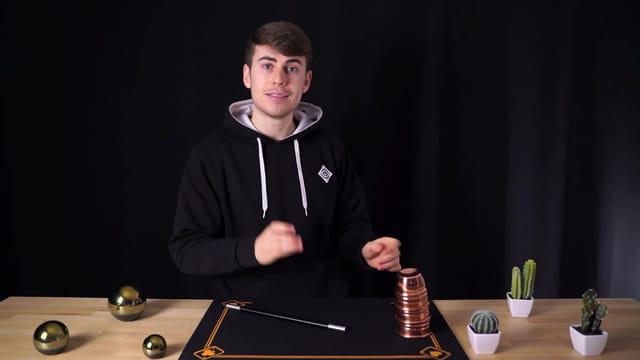
Using Wands for Misdirection
The Common Mistake: "Empty Hands"
Most people think that to prove their hands are empty, they need to keep them open and stiff. You might feel like you're under a microscope, trying to show there's nothing hidden. But when you move too carefully or keep your hands unnaturally open, you actually draw more attention to them. Spectators start wondering exactly what you’re trying to hide.
Why It Matters
When you use a prop like a wand, a pen, or even a coin to "occupy" your hand, the psychology changes. It’s hard for a spectator to believe you’re palming something when your hand is busy holding another object. This simple shift creates a gap between the moment you place an object and the moment it vanishes, which breaks the link in the spectator’s mind between your movements and the trick.
What You'll Learn
In this lesson, you'll learn how to use "cover" to make your vanishes invisible. We break down why holding an object makes your sleights more convincing and how to use temporal separation to your advantage. You'll also learn the importance of symmetry—keeping both hands looking like they are doing the same thing—to avoid suspicion.
We don't just talk theory; we look at the mechanics of the "real move" versus the "false move." You’ll learn how to practice the actual act of tossing an object so that when you perform the fake, your body language remains identical.
About the Instructor
Julio Ribera is a Spanish magician who has spent years teaching the fundamentals of close-up magic to over a million followers. He focuses on practical, real-world applications of theory, ensuring that every concept you learn is something you can use in your next performance.
What's Included
- Why props provide natural cover for palming
- Using temporal separation to mask the moment of a vanish
- Maintaining hand symmetry to keep your moves clean
- The difference between the "real move" and the "false move"
- How to apply these principles to wands, pens, and coins
Frequently Asked Questions
What if I don't use a wand in my act?
That’s fine. The theory applies to anything you hold—a pen, a marker, or even the cups themselves. Anything that occupies your hand acts as a natural cover for your secret work.
How do I know if I'm doing it right?
If your hands look like they are doing the exact same thing in the real move and the fake move, you’re on the right track. If you find yourself hesitating during the fake move, you need to go back and practice the "real" movement until it feels as natural as breathing.
Is this only for Cups and Balls?
While this is a staple of Cups and Balls, these principles work for almost any vanish in coin or card magic. The goal is to make your movements look ordinary, not "magical."