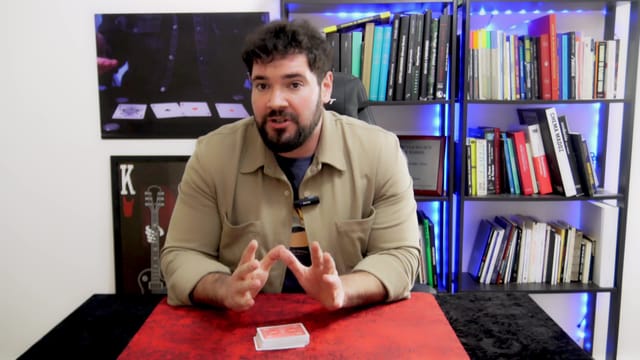
Yellow Card Routine
What It Looks Like
You talk about the old theater superstition that the color yellow brings bad luck to performers. To prove you don't believe in superstitions, you have a spectator thoroughly shuffle and cut the deck as much as they want. Despite their complete control over the cards, you identify their chosen card with total confidence.
Why It Works
This routine relies on a clever marriage of audience management and solid card handling. By framing the trick around a superstition, you give the spectator a reason to shuffle and cut, which makes the eventual reveal feel impossible. It’s not just about the move; it’s about making the spectator feel like they are the ones who made the magic happen.
What You'll Learn
You’ll learn how to structure a routine that feels like a story rather than just a series of moves. Luis Olmedo breaks down the psychology of the "Yellow" performance, showing you how to handle the deck after the spectator has shuffled it. You will learn the specific handling required to maintain control while appearing relaxed, and how to use your presentation to sell the effect.
The lesson focuses on building confidence in your performance. You aren't just memorizing a sequence; you are learning how to turn a simple card discovery into a memorable moment.
About the Instructor
Luis Olmedo is a World Micro Magic Champion and a Penn & Teller: Fool Us winner. He is known for his technical precision and his ability to turn conceptual ideas into powerful, engaging close-up routines.
What's Included
- The full performance of the "Yellow" routine
- Handling for spectator-shuffled decks
- Techniques for maintaining control during interactive routines
- Performance tips on building confidence and presentation
Frequently Asked Questions
What props do I need?
Just a standard deck of playing cards. No gimmicks required.
Can I do this surrounded?
Yes. Since the routine is based on natural handling and audience interaction, it works perfectly in close-up environments.
How much practice does this take?
The moves are manageable, but the real practice is in the presentation. You want to reach a point where you aren't thinking about the cards, but rather the story you're telling.
Does it matter if the spectator shuffles poorly?
Not at all. The structure of the routine is designed to work regardless of how the spectator handles the cards.