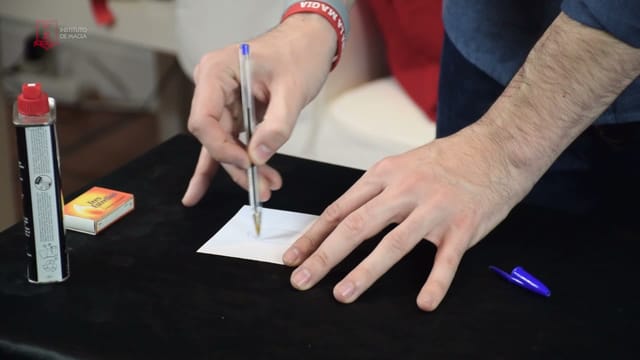
Center Tear: Technique and Presentation
Center Tear Applied to a Mentalism Routine
Borja Montón presents a routine in which a spectator thinks of and writes down a place, destroys the paper, and ultimately discovers that the magician knows their choice. Following that performance, he explains the center tear, a classic mentalism technique, and how to integrate it into a complete presentation. The version he develops is based, as he indicates, on 13 Steps to Mentalism, by Corinda, with his own handling and presentation details.
Paper Preparation and Handling
The explanation begins with the choice of paper and writing instrument. Size, shape, folds, and legibility are studied, along with the instructions given to the spectator for writing and folding without confusion. Borja compares the two possible folding orientations and walks through the handling from the magician's perspective.
The technical work covers the tear, finger palm, hand coordination, and actions in transit. Pocket organization and the props involved are also explained so that movements have a purpose within the routine. Attention is given to posture, arm movement, and any noise the paper might produce.
Naturalness, Attention, and Remembering the Effect
A core part of the class deals with timing and the patter that accompanies the handling. You will learn to avoid rushing, give clear instructions, and leave space between the different phases. The parenthesis of oblivion is explored, along with how to direct attention so the audience remembers a thought-of word and a revelation without making auxiliary props take center stage.
Borja explains how to integrate a writing area onto the paper without unnecessarily drawing attention to it. He offers an optional crease preparation to make instructions easier and discusses various presentation justifications. You do not need to adopt an esoteric persona or copy his pirate story; that story is simply used as an example of fiction giving meaning to actions.
Angles and Performance Conditions
The main handling is studied standing up with access to pockets. The class points out its limitations when surrounded by spectators and proposes alternatives for working seated or with a notepad. Lapping is described and roughly illustrated; a complete seated and surrounded performance is not presented.
The notepad allows for studying another way to organize movements and display the revelation. These examples help evaluate which handling fits the actual layout of the audience, table, and wardrobe, rather than assuming the same sequence works from every angle.
Revelation and Presentation Variants
Two endings are compared: writing the word in a notepad or using a map on a phone to reveal a place. It explains when it is best to show the answer to the rest of the audience and how to build the moment when the participant confirms their choice.
The limitations of the smartphone are also discussed: it can cause the audience to attribute the result to technology, and not all possible answers correspond to a place that can be shown on a map. The written alternative preserves the presentation when that prop does not fit.
The initial performance uses fire, but the technique does not require it. The final block explains a non-fire variant with two pieces of paper and a comedic presentation centered around inverted writing. It is developed as a handling and script alternative, without a second full spectator performance.
Materials and Practice
To begin, you need paper and a pen or pencil that does not bleed through. It is advisable to have several pieces of paper for rehearsal and clothing with accessible pockets for the main handling. The notepad and smartphone with maps are revelation options; they are not necessary to learn the technique. The non-fire variant uses two pieces of paper. The initial presentation adds a heat-resistant container and ignition elements.
You do not need prior knowledge of the center tear: its moves and application are explained during the class. It does require practice before performing, both to handle the paper with precision and to coordinate your gaze, hands, pauses, and patter. The goal of rehearsal is to be able to attend to the spectator without rushing or dwelling on every single move.