Card Estimation and Four of a Kind Production
From a cut to a final production
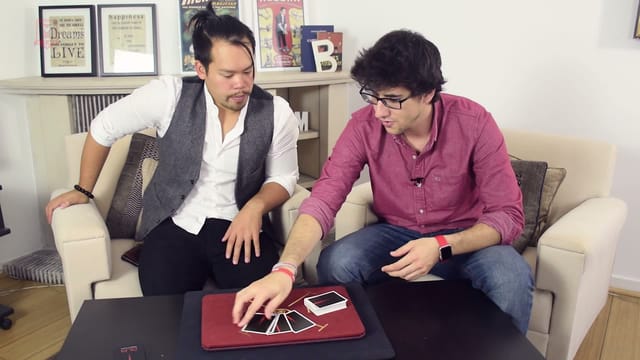
The spectator cuts, remembers the value of a card, and returns the packet. Think Nguyen repeats the cut to find a card of that same value. The demonstration increases the apparent difficulty by switching hands and closing the eyes, before finishing with the production of the four cards of a named value.
The recording includes consecutive Spanish translation by Borja Montón. The explanation combines deck preparation with the construction of the presentation: a repeated action can remain interesting if each repetition alters the conditions perceived by the audience.
Preparation and handling
A stack is taught that facilitates approximate location by packet thickness. The class shows how to set it up manually and discusses a Faro shuffle option for anyone who has already mastered that technique. The manual setup allows you to study the routine without making the Faro a requirement.
The instructor explains a false shuffle in the hands and discusses another handling that preserves the stack. Continuity while speaking, variation in pacing, and a casual attitude with the deck are worked on. The goal is for the presentation not to be interrupted by a shuffle executed as if it were a card-counting exercise.
In the early phases, you study how to observe the thickness of the cut, return the packets squared up, and adjust the location. For the climax, the use of a peek and a slip cut is explained, with repetitions that allow you to follow the sequence before performing it at performance speed.
Building a clearer climax
Theory suggests two ways to build an effect: increase its apparent difficulty and eliminate explanations the audience might imagine. The possibility of having a spectator perform one of the locations is even discussed, adapting the instructions to that participation.
The climax shifts the pace and brings the four reveals together. Showing them one by one is compared with saving them for a combined finish, and cuts and presentations that preserve the sense of searching are studied.
You need a regular deck prepared as explained and a table. It is helpful to handle basic cuts and practice the false shuffle and the slip cut separately. The examples with other objects or gestures are presentation options: the main study is done with the deck and your hands.