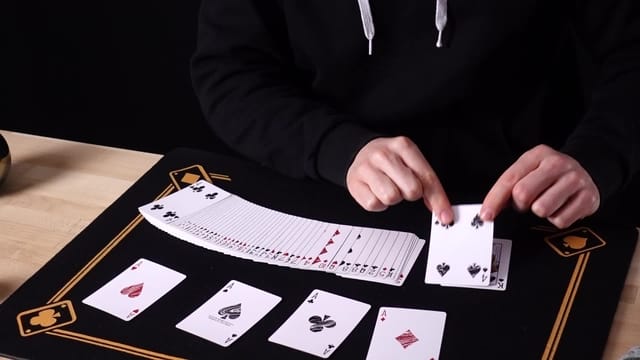
The One-Armed Aces: Setup and Control of the Aces
Preparing the sequence within the performance itself
The starting point is an ordinary deck that can be shuffled and borrowed. The setup required for The One-Armed Aces is built during the effect, as you take out the aces and lose them again in different packets.
Julio Ribera develops this preparation in detail and repeats it as a continuous sequence. The goal is to understand what function each action serves before adding the ace productions.
Choosing and placing the key card
You will study the function of a numerical card in the climax of the apparent miss. Julio explains how to incorporate it while searching for the aces and why he prefers values that allow resolving the final count without dragging it out.
The placement is integrated into the search for the cards. Next, the loss of the aces into the packets is worked on, with the option of fanning the cards or using a spread.
Maintaining breaks and executing cuts
The tutorial teaches ways to obtain a pinky break over one or two cards, paying attention to touch and finger placement to maintain control. The pinky count appears as a more advanced alternative; the options developed for beginners are the riffle and sliding the cards.
It also explains how to maintain the break when moving from Mechanics Grip to Biddle Grip and executing the double undercut. For the bottom part, the buckle and a riffle alternative are studied, along with the combination of a swing cut and a double undercut that completes the setup.
The final repetition brings the work together in order so you can check how each part fits.
Accompanying the handling with a story
Julio insists that the patter must sustain interest while the aces are lost. He recommends studying Lavand's and Tamariz's performances and adapting the story to your own presentation.
The video relates audience attention to movements toward the cards and the naturalness of the actions. Practice consists as much in maintaining positions as in avoiding that the preparation becomes a succession of meaningless instructions for the spectator.
Materials and prior study
You will need an ordinary deck and a surface to distribute the packets and the aces. The explanations review the grips, breaks, and cuts used in this sequence; it is best to practice them in parts before bringing them together.
The explained setup serves as the basis for the one-handed and two-handed productions of The One-Armed Aces. Practice it until you can perform it smoothly and recognize the function of each control.