Openings and Opening Tricks for Family Shows
Building the Beginning of a Family Performance
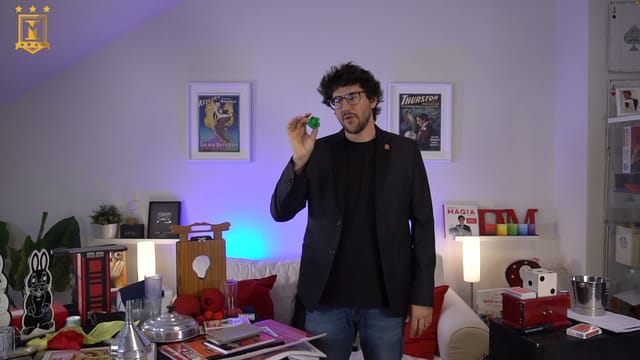
Borja Montón brings together routines and presentation criteria for the first few minutes of a show at weddings, baptisms, communions, or birthday parties. The journey ranges from a visual opening to audience participation from their seats and the arrival of the first assistant.
The idea is to choose based on what you want to convey, your performing style, and the venue's conditions. You don't need to buy the entire collection shown: some pieces receive a detailed explanation while others are presented as options for your repertoire.
Bottle, Glass, and Drawn Object Productions
The class begins with a sequence linking a wine bottle, a glass, and a water bottle produced from a drawing pad. Next, the bottle production with a handkerchief is explained, covering preparation, wardrobe, angles, posture, and body-hand coordination. Different placements are compared and the move is repeated for practice.
A balloon variant and a commercial loader are also shown. Borja discusses their differences in comfort and handling, as well as the challenges of working surrounded by spectators. The glass production is explained separately, using a routine's everyday action to give it meaning.
With the Super Pad drawing pad, the operation and presentation of a drawing-linked production are taught. Compatible items and the importance of supporting original creators are discussed. This is an operational explanation, not a complete manufacturing workshop.
Other Opening Possibilities
A glowing butterfly blendo and colorful boxes appearing from a bag allow for a comparison between musical and visual openings. The effects of lighting, material customization, and the relationship between the props and the show's theme are discussed.
The blendo is shown, but its complete folding and preparation are not covered. Food to Go appears next as another production option; it is briefly discussed and handled, without a complete, rehearsed explanation of its handling. References to doves, card manipulation, or canes expand the available ideas, but do not constitute courses in those specialties.
Presenting the Premise and Engaging the Audience
Following the opening, Borja suggests explaining what the performance will be about and introducing an object that may gain significance later. A locked box and its operation are shown, and a gravity lock is mentioned as an alternative for a storyline thread.
The Die Through is used to develop a presentation where children think they figure out what is happening and participate before the final surprise. The sequence and its patter are demonstrated; a complete study of all the apparatus's mechanics is not provided.
The jumbo invisible deck and coloring book, featuring a large-format version, are also presented. Visibility, collective participation, and choosing the right timing are discussed: Borja distinguishes an interactive trick from one he would use as an immediate opening. David Kaye's routine, Silly Billy, is recommended as a reference, but is not fully developed here. The invisible deck and silk-to-egg require familiarity with their handlings through other means.
From the Group to the First Assistant
To move into a development routine, sponge tricks, larger finales, and object travels are discussed. The adaptation of sponges into tomatoes illustrates how to give a theme to a familiar prop; a complete sponge routine is not taught.
The bill tube receives a demonstration and an explanation of how it works. The presentation of a closed container and the reappearance of a signed bill are studied. The prior phase of exchanging or vanishing the bill is assumed to be known, so you will need to have that handling ready to complete the application.
Card to Handkerchief and Two Ways to Switch an Object
The final part uses the production of a drawn card from a handkerchief to work on two switches. Eye contact, the justification of actions, and coordinating attention with movement are explained. Afterward, an alternative is developed using the card case and the assistant's participation.
Details include where to position the spectator, how to hand over the prop naturally, and why you shouldn't rush the gesture. Possible applications to envelopes, predictions, and other objects are discussed. To complete the card to handkerchief, knowing a card force is necessary; here the detailed work focuses on the switches and their presentation.
Props and Preparation
To practice the productions, you need a jacket and clothing that allow for the explained handling, a bottle, a glass, and a handkerchief; the balloon variant uses its own accessory. Working with drawings, the Die Through, the coloring book, and the bill tube requires the corresponding equipment. Choose only the pieces that fit your performance.
For the card to handkerchief, appropriate handkerchiefs, a rubber band, and a deck with a case are used; a small prop, such as the pendulum shown, can be part of the presentation. It is helpful to have basic fluency with cards and small props, know a bill switch or vanish if you are going to use the tube, and rehearse loads, angles, and handovers before performing.
The commercial examples belong to the time of recording: their current availability is not guaranteed, nor are the accessories included. The class offers a selection of openings and handlings to build your own sequence, not a complete ready-to-perform show.