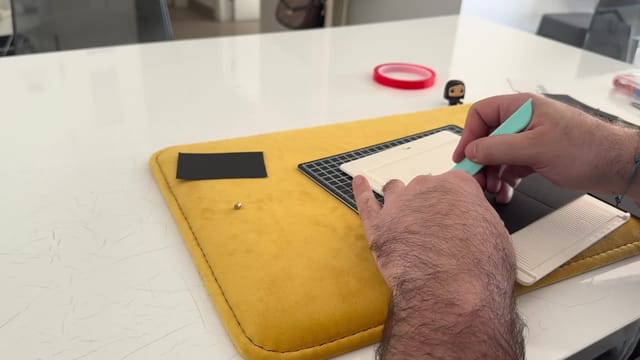
Appearance Object: Building and Handling a Cardstock Folder
A piece of cardstock appears to be empty, and after closing and reopening it, a small object appears that can be handed out to the spectator. Julio Montoro demonstrates the effect with a figure and teaches how to build and handle the complete piece.
The example adapts the appearing toy car idea to another object. The explanation covers a cardstock construction and a handling that you will have prepared before performing.
Layout, Cutting, and Creases
Julio uses a business card as a reference to draw the structure. It teaches how to repeat the measurements, organize the layout, and cut out both the main piece and the auxiliary element.
Next, scoring and the crease sequence are worked on, paying attention to the fit of the parts. A scoring board or machine makes the work easier, but Julio explicitly states that it is not mandatory. The important thing is that the folds allow the piece to close and open as explained.
The construction is reviewed in the video so you can connect the flat layout with the shape it takes when folded. The explanation also shows how to adjust the element that completes the assembly.
Assembly and Object Adaptation
The placement of double-sided tape and the eight magnets is taught, along with how to cover the assembly to finish the piece. The tutorial distinguishes between the parts seen when performing the effect and those that remain facing the magician.
The preparation for the object changes depending on what you want to make appear. Julio compares holding a small figure to holding a toy car. These are examples of objects suited to the size and assembly; it does not mean that any object, regardless of its dimensions, will work for the same piece.
Once construction is finished, it explains how to set it up ready for performance.
Handling and Presentation
The tutorial goes through showing the cardstock looking empty, the closing, and the opening that produces the appearance. The turns and orientation that the piece must maintain relative to the audience are pointed out.
The spectators are positioned in front. The view from behind is used to teach how the mechanics work, and is not the position from which the effect is performed.
After the appearance, it explains how to remove the object from its holder and hand it out as a souvenir. At the end, an application using two pieces is discussed to combine a vanish and an appearance; the construction and main handling covered are those of the piece shown in the tutorial.
Materials and Practice
You need black cardstock, eight magnets, double-sided tape, a pencil, a business card as a reference, scissors, and a small object compatible with the assembly. The scoring tool is optional. You do not need to buy a brand-name appearing gimmick.
Practice the construction first and check the closures and folds. Then rehearse the front-facing orientation, turns, and the timing of the appearance. The object used and how it is held must be part of that preparation.